Home Blog Page 419

Fortnite Content Update 7.10 #2 – Adds Boom Box, New Prefabs & More

Epic Games has finally released their second content update under Content Update 7.10. The newly released update features and adds a bit of content to the game throughout the three modes available.

Fortnite Gets A New Boom Box

The major addition coming to the Battle Royale mode of the game is the new Boom Box. With the new boom box, players would be able to tear through the defense of your enemies.

The newly-introduced boom box adds a ton of boogie to the game. However, if it gets out of hand, players could disable it by simply shooting at it.

Not only is the boom box coming to the Battle Royale mode of the game, but it would also be coming to Fortnite’s Creative mode too.

New LTMs in Fortnite

As Epic continues with their “14 Days of Fortnite” frenzy, Epic has announced some major news for those LTM geeks out there. Following this update, Epic would be adding and vaulting LTMs every day or two depending on how major that LTM is.

Beginning at 9 AM ET(1400 UTC), players would be able to see their LTMs refresh and introduce new limited-time modes every day.

New Ice-Themed Prefabs Are Coming To Fornite’s Creative Mode

With the latest update, players would be able to access new prefabs and galleries while accessing Fortnite’s Creative mode.

First introduced with the launch of Fortnite Season 7, the new mode has become an absolute legend as players are able to take their creations to the next level.

In total, the latest update would be adding a total of eight Ice Castle prefabs and 5 Ice Castle Galleries.


Fortnite Content Update 7.10 – #2 – Patch Notes


BATTLE ROYALE

WHAT’S NEW?

Drop the bass with the newest item available in Battle Royale, the Boom Box! Crank the volume and toss it at enemy structures to tear down their defenses.

BR07_Social_BoomBox.jpg

LIMITED TIME MODES

The 14 Days of Fortnite event will feature both new and returning LTMs. Large team modes switch every two days and small team modes rotate every 24 hours.
Log in each day at 9 AM ET(1400 UTC) to find out which modes are available to explore. Let us know which LTM is your favorite on our social channels!

WEAPONS + ITEMS

  • Boom Box
    • Activate to create powerful blasts of music that deal structure damage in a large area!
    • Newly built walls in the radius of the box are destroyed with every blast.
    • Shoot the Boom Box to stop its effects.

CREATIVE

WHAT’S NEW?

Ice Castle Prefabs
Sculpt your masterpiece in Creative with 8 new Ice Castle Prefabs!
EN_CM07_Social_Prefab_IceCastle.jpg

This is an early release so you may experience client crashes, loss of progress, or other unexpected errors.

WEAPONS + ITEMS

  • Boom Box added to Creative Inventory Consumables
    • Activate to create powerful blasts of music that deal structure damage in a large area!
    • Newly built walls in the radius of the box are destroyed with every blast.
    • Shoot the Boom Box to stop its effects.

PREFABS

  • 8 Ice Castle Prefabs
  • 5 Ice Castle Galleries including with and without snow

SAVE THE WORLD

MISSIONS + SYSTEMS

  • Weekly Frostnite Challenge Missions:
    • Each week during the Frostnite event, there will be a new Weekly Challenge mission in the Frostnite zone.
    • These zones include specially crafted challenges to push player’s skills using a variety of modifiers
    • Weekly Frostnite Challenge 1: Slip Out
      • Touching snow or ice will cause players to slide. Use building to your advantage!
      • Weekly Frostnite Challenge 1 Quest rewards include:
        • Challenge Banner 1
        • Tree of Light Sword
        • Snowflake Tickets

HEROES

  • Crackshot Soldier available as a quest reward from 14 Days of Fortnite.
    • A Legendary variant of the Rescue Trooper subclass.

WEAPONS + ITEMS

  • The Pain Train Assault Rifle will be available on the Weekly Store
    • Assault rifle with a slow rate of fire that packs a punch per shot.  Slow and steady wins the race!
    • Available in the Weekly Store from January 2 at 7 PM ET until January 9 at 7 PM ET.
  • The Tree of Light Sword will be available as a Frostnite Weekly Challenge reward
    • A slow, edged weapon with high damage per hit.
    • Includes a new 6th perk that stuns nearby enemies after 8 hits.

Essential To Release A New Phone Next Year – The Essential Phone 2?

0

Essential made a huge splash when it first introduced their brand to the market. Their first device, the Essential Phone, made headlines for its amazing design at the time. Built by the father of Android, Andy Rubin, the Essential Phone had a lot going for itself. Fast forward one and a half years into the future and it seems like the company has ditched its business.

That’s all about to change in the near future as major news has just come out of the Essential team where Jason Keats, the Head of Research and Development, announced that they aren’t done with the Essential Phone yet, that too, by a “long shot”.

It has been more than a year since the Essential Phone first dropped. Back then, the Essential Phone stunned users for its amazing design and excellent specs. Back then, the original Essential Phone featured some incredible hardware for the time, we’re talking about a Qualcomm Snapdragon 835 SoC, 4GB RAM, 128GB of internal storage and a notch that kicked off a trend throughout 2018.

The phone’s design definitely was one of the most intriguing parts of their phone. Featuring a minimalist body along with a notch that everyone loved, Essential had something going for themselves. Couple that with stock Android and the fact that Essential had plans to release accessories that would snap onto the back of the Essential Phone and we had a device that could have potentially enticed a generation of smartphone users.

However, following the launch of the original Essential Phone, many enthusiasts and users felt disheartened to see that the company hadn’t released a successor to the original Essential Phone while other phones caught up with the hype train that it had once started. Essential’s official website continued retailing the device until last week and had finally taken the original Essential Phone off of their website telling the folks over at 9to5Google that the device won’t be coming back as the company has begun to shift its focus towards its “next smartphone”.

That “next smartphone” hype was further amplified in the tweet as aforementioned with the Head of R&D tweeted…

All these stories about Essential’s demise just end up feeding my desire to rub their faces in it in the future. We aren’t done, not by a long shot. – Jason Keats via Twitter

Essential has pretty much left their mark on the smartphone market. Given that they are working on a successor to the original Essential Phone, it’s likely that the next Essential Phone would feature up-to-date chipset such as the Qualcomm Snapdragon 855 and would follow the same price tag as the previous release.

Taking into account that is had been more than fifteen months since the Essential Phone hit the market, we’d be curious to see when Essential plans to release the successor as Samsung and OnePlus kick off the year with their flagships with the Galaxy S10 and OnePlus 7.

PUBG Regains Over 10% Of Its Players With The Launch Of Vikendi

0

PUBG by Bluehole was undoubtedly one of the most influential multiplayer titles of 2018 beside Fortnite and Rainbow Six Seige. The game shaped up the Battle Royale genre like no one else and the early access was an instant success. Ever since then PUBG devs kept on adding bug fixes and new content but the player base kept on a steady decline. It is clear that Fortnite is now the most influential title in the category thanks to the active bug fixing and major season updates, unlike PUBG.

One major reason why PUBG player base was in decline for over 10 consecutive months was the fact that Bluehole instead of fixing existing bugs and improving the optimization of the game kept on adding new weapons, maps and other sorts of content to the game. This made the player base furious and rightly so for how bad the game worked and how often it crashed. Apart from PCs, the game ran absolute garbage on the Xbox and the PS4.

Despite all that, the player base has finally shown a positive delta which could with over a 9.55% increase in player count over the last 30 days. The average players accounted about 458,091.2 which is a definite improvement over last month but is still 11,000 shy of what was counted way back in October. It is clear that Fortnite’s Battle Royale mode had a very substantial impact on the game and the player base shifted significantly to the Epic Games title. Before 2018 PUBG was doing quite well at a steady pace with more and more players joining the game but ever since other games like Fortnite, Call Of Duty and Battlefield gained popularity in the Battle Royale genre the numbers have been sinking rapidly.

The title had about 3 million peak players at the start of 2018 but it ended up losing one-third of its player base but we may see some improvement in the rating thanks to the new FixPUBG movement initiated by devs. All this increment could also be the result of the holiday season and the much-increased playing hours but we hope that the player count grows back into its former glory.

Xiaomi Mi 8 Gets 960FPS Super Slo-Mo Video Recording

0

Xiaomi has finally offered some amazing news for Mi 8 users today. In a blog post released today by the folks over at Xiaomi, Xiaomi has announced that they’ve finally enabled 960 FPS super slo-mo video recording for the Xiaomi Mi 8 family of devices.

However, it doesn’t end there. Similar to the Poco F1’s 960 FPS update, in addition to enabling 960 FPS super slo-mo video recording, Xiaomi has re-iterated and has added some low-light improvements for the Xiaomi Mi 8 as well. With the addition of 960 FPS super slo-mo video recording, users should now be able to get some amazing super slo-mo videos with their Xiaomi Mi 8 for those epic moments. Like the Poco F1 and the Mi MiX 3 that came before it, the Mi 8 does not record 960 FPS super slo-mo videos continuously but rather records the special bit for a few seconds in burst.

Thankfully this update would cover most of the Mi 8 family with the exception of the Mi 8 Lite and Mi 8 SE. It seems like Xiaomi has no plans to enable it for those devices given the hardware. However, for those who have the Mi 8 Pro at their sides, rest assured, Xiaomi’s got you covered and has promised to enable it for the Mi 8 Pro as well soon.

Altogether, Xiaomi has finally managed to add two new phones that support 960 FPS video recording out of a total of five devices that sport the Snapdragon 845 SoC. With the Poco F1 leading the charge with these massive updates, there’s a very good chance that Xiaomi’s shift of focus with the Poco F1 could very well be to leverage the testing of the features before its finally delivered to the Mi 8 and the rest of Xiaomi’s lineup.

What’s left to see from Xiaomi is the introduction of Netflix HD support and the addition of 4K / 60 FPS video recording for the Xiaomi Mi 8 now that the Poco team has confirmed that the 4K / 60 FPS recording feature is in its final stages. And given how active the team over at Poco is, we’d assure you that it isn’t far.

Xiaomi Poco F2 Geekbench Benchmarks Leaked – Snapdragon 845, 6GB RAM & More

0

Xiaomi has been on a roll throughout 2018. After a slight tumble in 2017, the company made huge improvements throughout 2018. One of the most shocking announcements that came from the company this year was the launch of a new sub-brand, Poco. Starting off with the Poco F1 as their first device, the Poco F1 (review) basically became the “flagship killer… killer” thanks to its flagship internals and an incredible $299 price tag.

Xiaomi’s Pocophone F2 Appears On Geekbench – Features Nothing New

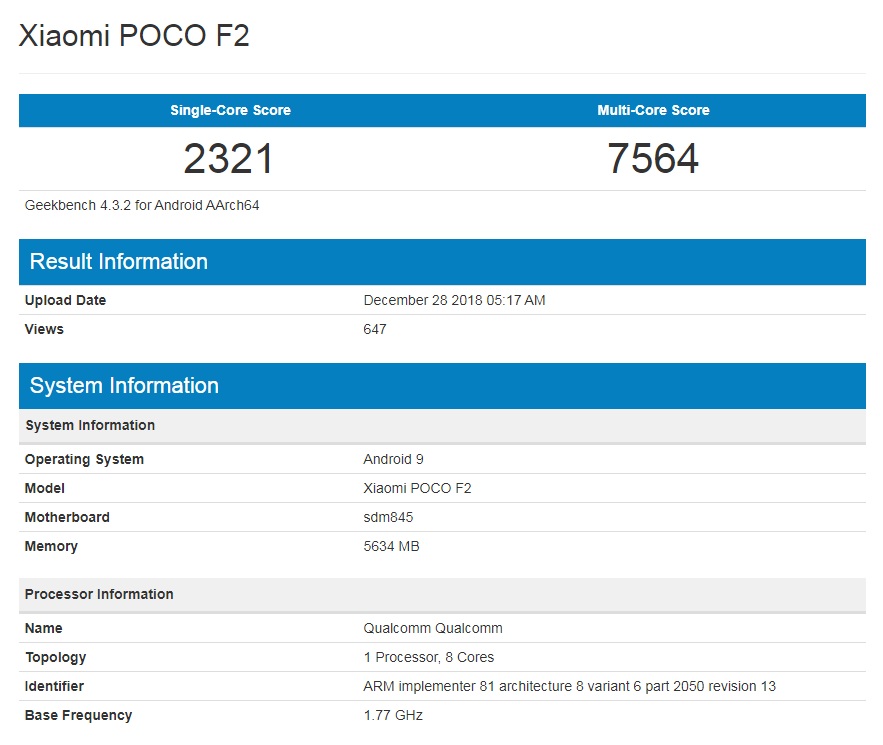
Just four months after its release, it seems like users or Xiaomi themselves are getting ahead of themselves already with leaks starting to pour around the internet suggesting the development of the successor to the Poco F1, the Poco F2. Leaked earlier this morning via Geekbench, there’s quite a lot of information that we could digest here.

The allegedly leaked Poco F2 has left a few marks behind on Geekbench, giving us an overall feel for what the device would pack under its clamshell. Based on the details derived from Geekbench’s database, the Poco F2 is said to pack a Snapdragon 845 SoC, 6GB RAM and would run on Android 9 Pie out of the box. Furthermore, the device managed to score 2321 and 7564 in single-core and multi-core tests, respectively, which is quite in line with what other Snapdragon 845-powered devices land at in benchmarks.

Here’s Why This Poco F2 Leak Is Fishy

Since Geekbench doesn’t record the most trustworthy leaks, we’d call this leak a spoof as it seems too unorthodox for the newly-formed brand to release a successor to its largely-successful Poco F1, that too with the same internals as the current Poco F1. In addition to that, the folks over at Poco have been amazing at supporting the Poco F1 and making sure that its user base remains happy with frequent updates and new features.

With such leaks already making their way onto the internet and given that these leaks are largely faked, we could easily see how well Xiaomi has managed to build hype around its sub-brand Poco.

Not only have they managed to release a “cheap” flagship, but they’ve managed to excel with it thanks to their interest in taking feedback. Some of their most recent examples include the fact that they’ve enabled 4k/60FPS on the Poco F1 and have also enabled 960 FPS slo-mo video recording all-the-while making sure that weekly updates are delivered to their devices. While players have managed to find their workaround by unlocking their bootloaders, what’s left to be seen is when they would be enabling Netflix HD for the Poco F1 officially.

Given how well they’ve been keeping Poco F1 users occupied, there’s no way Poco would release a device this soon, that too, with a now last-gen SoC. Although if it does happen, the trainwreck would be worth watching, that’s for sure.

Nokia 9 PureView To Be Launched in January 2019

0

The Nokia 9 is coming very soon. According to a Chinese website CNBeta, the Nokia 9 is set to launch in late January 2019. The news comes through insiders at Nokia Anew. The Nokia 9 is one of the most anticipated upcoming smartphones, mainly due to its unusual design. The exact date of the release is not revealed, so it could be subjected to change, just like with the Nokia 8.1.

The phone is rumored and leaked with a surprisingly unique design; mainly the cameras. The Nokia 9 PureView is going to feature five rear cameras with a separate depth sensor. So far, the details about the five cameras are unknown, however, the phone does look promising.

Nokia has been very different in their approach to the design of their phones, especially the PureView series phones. The Nokia 9 PureView is kind of a successor of the Nokia Lumia 808 PureView, which debuted back in 2012 with a whopping 41MP rear camera. This figure is considered pretty high, even to this day.

As for the specs, the Nokia 9 PureView is rumored to feature Qualcomm’s Snapdragon 845 SoC, 8 gigs of RAM and a 5.9″ AMOLED display. We have no details on how Nokia is going to pull off the five cameras, but with Zeiss optics and top-notch sensors, the cameras seem to be very promising. It is also going to feature an estimated 4100mAh battery. It’s a bummer that the phone isn’t going to feature the Snapdragon 855 SoC, which further means that the Nokia 9 most likely won’t have 5G capabilities.

At this size and specs, it is safe to say that the Nokia 9 is Nokia’s first proper flagship device. But with these specs and design, it is going to cost a handsome amount of money. Still, if Nokia prices the Nokia 9 competitively, it can tip over the competition and give a hard time to the Samsung Galaxy/Apple iPhone devices.

Huawei Honor V20 Revealed – A Sub-$450 Flagship With A Kirin 980 & 48MP 3D-Camera

0

Huawei has finally unveiled the Huawei Honor V20. In a teaser trailer posted today by the Chinese manufacturer, Huawei has completely blown off some bells and whistles as we head into 2018.

Huawei’s Honor V20 Is Honor’s Take To Compete With the OnePlus 6 & Xiaomi Mi 8

The new trailer released for the Huawei Honor V20 reveals a ton of goodies regarding the Huawei Honor V20. Beginning with the specs, the Huawei Honor V20 would feature Huawei’s latest and greatest Kirin 980 SoC, a 6.4-inch FHD+ display, a 4000mAh battery, up to 8GB RAM and up to 256GB of internal storage. In addition to that, Huawei is continuing to push its punch-hole camera design with the V20 following the release of the Huawei Nova 4. Here, with the V20, we get to see a 25MP sensor up front, while the real two camera sensors consist of a 48MP IMX 586 and a 3D ToF camera sensor for some excellent depth mapping, similar to what we see on the new iPhones.

Being a Huawei device, Huawei has also made sure that they include their take on improving the overall experience too. With the Huawei Honor V20, we continue to see Huawei pushing their GPU Turbo 2.0 technology along with a few WiFi and vapor-chamber cooling improvements. In addition to that, we get to see Huawei’s usual AI tweaks along with an enthusiastic push for AR applications.

Huawei Honor V20’s Storage/RAM variants & Color Options

The device is said to come in three colors as well as three storage and RAM variants. Beginning with the colors available for the device, the Huawei Honor V20 does come in Charm Blue, Charm Red and Midnight Black, each of these devices featuring an aurora back with a V-like pattern as light shimmers onto its back.

Regarding the storage and RAM variants available with the device, it seems like Huawei would be releasing these devices in three flavors. The base variant of the device features 6GB of memory paired with 128GB of internal storage. However, if you do plan to bump that up, there are two more options you’ve got here. The next variant features 8GB of memory paired with 128GB of internal storage while the last variant, in partnership with MOSCHINO, features 8GB of memory along with 256GB of internal storage.

Huawei Honor V20 – Pricing & Availability

What’s worth mentioning though is the fact that the Huawei Honor V20 lacks an under-display fingerprint sensor while Huawei continues to keep that as an exclusive with their Huawei Mate 20 and Mate 20 Pro. Furthermore, while we have seen the device in its entirety throughout the past week or two, the Huawei Honor V20 would not be arriving in international markets before 2019 begins. Huawei has announced that the device would begin retailing today, while the international debut of the device has been set for January the 22nd in Paris, next year.

Based on Chinese listings, the base variant of the device is said to retail for CNY 3000 (US $437). While the 8GB/128GB variant would retail for CNY 3499 (US $509). Pricing regarding the MOSCHINO variant does seem to be unavailable at the moment. However, we’d speculate that the variant would cost no more than CNY 4000 (US $582).

Huawei Honor V20 – Image Gallery

Leak: Motorola P40 5K Renders Show A Punch Hole Design & Much More

0

The idea of having a tiny hole in the front screen of your smartphone may seem a little different but it all makes sense when it comes down to hardcore enthusiasts. As 2018 comes to an end so does the notch and with it comes a brand new trend set by Samsung and Huawei to overcome the notch. The punch hole design seems to be gaining a lot of popularity and is expected to take the place of the notch next year.

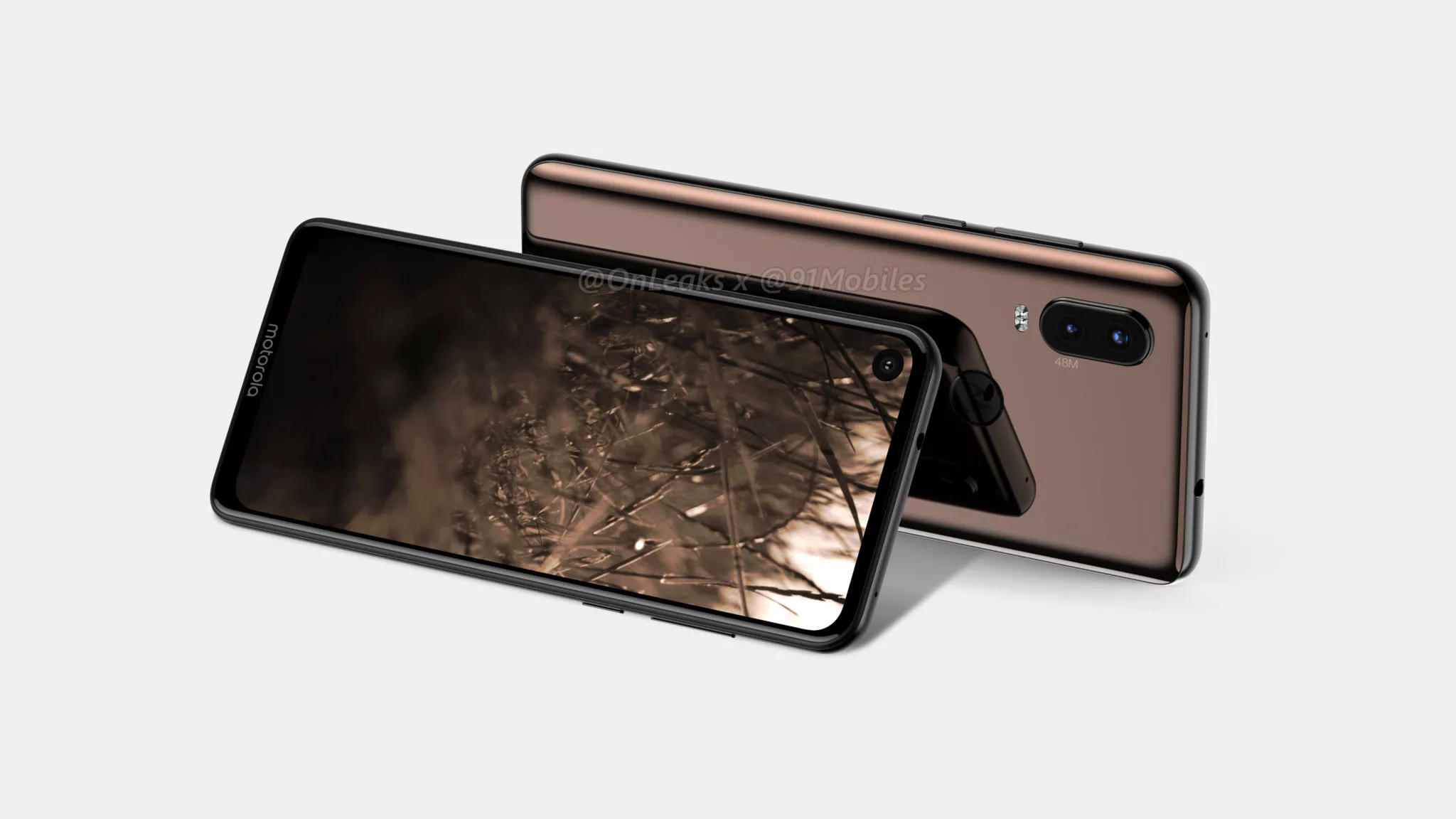
The latest leaks of the Motorola P40 courtesy of folks over at 91mobiles showcases a punch hole design while maintaining the Motorola characteristics. The device has fairly minimal bezels while hosting a fair sized chin labelled with the Motorola branding. The phone looks premium being covered in glass and metal while having a shape quite similar to the iPhone XS. The phone hosts dual rear-facing cameras with a 6.2” Inch display. Moreover, the device will keep the 3.5 mm headphone jack with a USB-C charging port. As far as security is concerned, the Moto P40 will have a fingerprint sensor embedded into the back logo while having all the neat face unlock features.

One thing of notice here is that the Moto P40 will come with Android One out of the box which brings stock Android to the device and guarantees over 2 years of major updates for the smartphone. Since the phone is expected to release next year we can expect it to host the brand new Snapdragon 855 including the X50 5G modem. The specifications are yet unknown but Motorola has been keen on making quality flagships for an international audience. The P40 is to have a single front-facing camera and the punch hole seems to be the size of a Galaxy A8s.

Given how LG and Samsung have actually stepped up their game and with growing competition in the Asian region thanks to Chinese manufacturers, Motorola itself has been in an awkward position for over a year now. Ever since the company made its comeback into the smartphone market it was steadily making progress but since 2018 it has all come to a halt. To make things worse manufacturers like Oppo and Vivo have also stepped in beside Xiaomi. For Motorola to actually make a successful flagship they would definitely need to bring something new to the table.


Samsung Tops Germany’s Durability Standards

0

Samsung has been phenomenal with its handheld devices ever since the release of the Galaxy S6. The combination of glass and metal gave Samsung devices a push in the right direction which has been acting as the driving force for the company up until now. With Samsung exploring various new technology in the department such as the foldable smartphone and the new punch-hole Galaxy S10, the tablet department will certainly not go unnoticed.

According to a study performed by Statista with over 11,000 German tablet owners participating, Samsung was rated to be the highest durability manufacturers among many. In fact, all the top 4 spots went to different Samsung devices with durability indexes averaging over 1.5. The Galaxy Tab 4 and Tab A ranked the highest with an index of 1.1 and the Galaxy Tab 3 Lite and Galaxy Tab S2 also received particularly favourable mention. In 2018 it is very much considered odd to be focussing on the durability of a device but Samsung is known for going on a separate path and this will definitely receive a ton of attention.

Apple with the iPad Pro has been phenomenal in terms of internals and the overall footprint and technology embedded but we discovered how poorly it was built geometrically and literally snapped in half. This leaves a tiny gap for durable and powerful tablets in an already tight market for Samsung to fit in. The Galaxy Tablets not only deem to provide durability which is often considered to be on top of everyone’s bucket list but also takes advantage of Android bringing in a complete desktop experience with Samsung DeX.

As 2018 comes to an end we look forward to what Samsung has in plan for enthusiasts in 2019. The productive market for electronic devices is bound to increase in this modern era and Samsung would certainly want to have a chunk of its share.

4K / 60FPS For The Poco F1 Is Ready – Becomes The First Sony IMX 363-Powered Device To Enable It

0

The showrunner, the Poco F1, has had an amazing run ever since it debuted back in August this year. However, with all of that power, a lot of enthusiastic users found out that their Poco F1 was unable to record 4K video at 60FPS out of the box. Following the launch, while Xiaomi’s newly formed Poco brand launched, Poco India’s, Jai Mani took it to Twitter calm down a ton of enthusiastic Poco F1 users regarding the absence of a 4K/60 FPS in which he promised to release an update that would enable it if a considerable amount of users request for the feature.

Following that promise, the Poco F1 has seen major improvements thanks to Xiaomi’s excellent OTA updates. Not only has Xiaomi managed to enable 960 FPS slo-mo for the Poco F1 (just like the one found on the Samsung Galaxy Note 9), but they’ve also promised to release an update that would allow Poco F1 users to experience Netflix in HD very soon. With 4K/60FPS underway, Xiaomi’s software team is speaking volumes here.

4K 60FPS recording
Development is done. Running final tests for maximum satisfaction – mentioned Xiaomi in their latest community update for the Poco F1.

For those who haven’t dug into the Poco F1, the Poco F1 uses the same main camera sensor on its rear as the Xiaomi Mi 8, Asus Zenfone 5Z and the Google Pixel 3/Pixel 3 XL family. Even the Pixel 3 and Pixel 3 XL lack 4K/60FPS recording. Neither of these phones are able to record 4K video at 60FPS with the exception of the Poco F1 now that development of the feature is in its final stages. While the Snapdragon 845 certainly does support 4K 60FPS, we thought that that the 4K/60FPS option wasn’t enabled due to the fact that the camera sensor was limiting the capabilities of what the SoC could achieve. Either way, this is massive news and it certainly tells us how focused the team over at Poco is.

There definitely seems to be a disconnect between the team over at Xiaomi and Poco now that the Poco is here. Not only is the Poco F1 leading the Mi 8 in features now, but it’s making the Poco F1 an even more enticing of a device that what many had expected.

Now all that’s left to be done by the folks over at Poco for the Poco F1 is to enable Netflix HD for the Poco F1 as soon as possible. Based on their initial Netflix HD release schedule, they’d better release it anytime now.

Whether other manufacturers are planning to follow Xiaomi/Poco’s suite is yet to be seen. But by the looks of it, Poco’s enthusiasm is definitely undeniable.

Samsung Galaxy S10 Leak Details Four Variants & Galaxy Note 10’s Display Sizes

0

As we head forward, leaks regarding the Galaxy S10 are continuing to pour in. In a new tweet posted by a trusted tipster, Ice Universe tipped the four variants of the Samsung Galaxy S10 and the Note 10 suggesting how large their display sizes are about to get.

New Samsung Galaxy S10 Leak Details The Display Sizes We Could Expect To See

According to the tipster, the Samsung Galaxy S10 is said to come in four variants, namely, the Samsung Galaxy S10, S10 Lite, S10 Plus, and Galaxy S10 5G edition. Furthermore, the tipster also decided to chime in regarding the display that we could expect to see on the Samsung Galaxy Note 10 as well, suggesting that the Note 10 would pack the largest display of them all displacing some of the information leaks had suggested earlier this year.

The exact size of the future Galaxy phone screen:
S10 Lite: 5.75 inches
S10: 6.11 inches
S10+: 6.44 inches
S10 5G version: 6.66 inches
Note10: 6.75 inches – said Ice Universe via Twitter

Not only did Ice Universe leak the display sizes, but there are a few key points that you should be keen to note over here.

First and foremost, it seems like the Samsung Galaxy S10’s variants would indeed be called the Samsung Galaxy S10, S10 Lite, and S10 Plus as conflicting leaks appeared online. Early leaks suggested that the Samsung Galaxy S10 would be dubbed as the Samsung Galaxy S10, S10 Lite, and S10 Plus. However, that was later contradicted as conflicting leaks suggested that the Galaxy S10’s variants would be dubbed as the Samsung Galaxy S10, S10 Plus, S10 X, and S10X 5G edition. Leaks regarding the Galaxy S10’s model numbers followed throughout the month of October with SamMobile even leaking the model numbers of the S10, S10 Lite, and S10 Plus, suggesting that the model numbers that new devices would be the SM-G970F, SM-G973F, and SM-G975F, respectively.

Samsung Galaxy S10, S10 Plus, S10 Lite, and S10 5G – Display Resolution, Ratio & PPI

We’re expecting Samsung to move on to the 19:9 or 19.5:9 display ratio next year. Taking into consideration that we had speculated the resolutions on these displays to be either 3120 x 1440 or 3040 x 1440 earlier this year, we could speculate the PPI of these displays now that Ice Universe has released information regarding the displays on the S10, S10 Plus, S10 Lite, and S10 5G. The display PPI turns out to be 550.54 PPI, 522.33 PPI, 585 PPI, and 505.08 PPI, respectively if it features a 19:9 display ratio. However, if it does feature a taller 19.5:9 display aspect ratio, we could expect a slight increase in the PPI as well. If the Galaxy S10, S10 Plus, S10 Lite, and S10 5G edition were to feature a 19.5:9 display ratio, the PPI should be 562.4 PPI, 533.58 PPI, 597.61 PPI, and 509 PPI.

The Samsung Galaxy Note 10 Would Feature An Even Larger Display, Larger Than The Ones Suggested In Previous Leaks

The next point that could be noted is regarding the Samsung Galaxy Note 10’s display size. Early leaks had suggested that the Samsung Galaxy Note 10 would feature a 6.66-inch display. Sourced from Ice Universe himself back in the day, it seems like the tipster could’ve received some major intel regarding Samsung’s shifts as he seems to suggest that that display size would indeed by the size of the Galaxy S10 5G rather than of the Note 10.

With this leaks, Ice Universe is bumping up his early suggestions from 6.66″-inches to 6.75″-inches. That’s a considerable leap, even more so when you take into consideration that the display on the Galaxy Note 9 is just 6.4″-inches large diagonally.

Samsung Galaxy Note 10 – Display Resolution, Ratio & PPI

However, what Ice Universe didn’t reveal is the display ratio and the resolution that these panels are set to offer. However, given how the market is heading, it’s not hard to predict that the Samsung Galaxy Note 10 would feature either a 19:9 or 19.5:9 display. Taking that into consideration, it’s not hard to speculate the resolution of these displays either. Given that Samsung has traditionally packed QHD displays ever since the Galaxy S5 on their devices, it’s likely that the Samsung Galaxy Note 10 displays would either feature 3040 X 1440 or 3120 x 1440 as their resolution if Samsung sticks to their traditional numbers. Since PPI isn’t that far off to calculate either, and that the intel we’ve received so far is true, the outcome PPI of the Galaxy Note 10 to be 509.08 PPI or 498.34 PPI.

Xiaomi’s Poco Team Is Teasing A New Device – Could Be A Snapdragon 855-Powered Poco

0

Xiaomi has just teased some major news for it’s newly formed sub-brand Poco. After garnering a massively successful run with the Poco F1, the folks over at the Poco division aren’t done with their launches yet.

In a series of tweets, Poco India has been tweeting continuously suggesting that they would be dropping major news regarding a new Poco device tomorrow. We already know why the Poco F1 (review) was a major hype generator, but if Xiaomi wants to continue its hype machine to roll on, it’d better be ready to really reveal some major news regarding their new Poco device tomorrow.

There’s a #NewPOCO in town? and it’s dropping here tomorrow! Are you ready? RT if you’re feeling hyped! – said Poco India on Twitter

So far, they’ve been explicitly been mentioning the arrival of a new device. However, only time would tell if this new Poco device would be an additional variant of the Poco F1 or if this would be the successor to the Poco F1. However, given how long the Poco F1 has been in the market, the latter of the two seems to be unlikely. However, the former could be possible too now that Lenovo has taken the lead on the Snapdragon 855 with the launch of the Lenovo Z5 Pro GT.

Given that they are still being vague regarding what the teaser is, there’s a good chance that Xiaomi could be preparing a mid-range device featuring a Snapdragon 660/675 SoC to tackle the newly introduced Realme 2 Pro and Asus Zenfone Max Pro M2. After all, Xiaomi must be feeling the burn as reports emerged that Realme had become the best-selling brand thanks to the Realme 2 Pro last month.

Now that there’s less than two hours left towards the announcement of this mysterious Poco device, we’re keen to see what bunnies Xiaomi would be pulling out of its “Agra-Kadabra” hat tomorrow. Simply judging by the tweets, I personally have high expectations for the device. Although, I’m just as skeptical too. Fingers crossed until tomorrow.

Xiaomi Mi Play Launched – Features Mediatek P35 SoC, Dual Cameras, 4GB RAM & More

0

After a number of leaks and rumors, Xiaomi has finally announced the Xiaomi Mi Play in China. And as we suspected, the SoC is indeed being sourced from Mediatek rather than Qualcomm with the Mi Play.

Early rumors and leaks suggested that the Xiaomi Mi Play would be the Poco F1 of China given that Huawei had announced their Honor Play for the mid-range market as well. Turns out, the Xiaomi Mi Play is rather a lower-end device from Xiaomi. However, on paper, it doesn’t seem to be all that bad.

Specifications & Features

On the inside, the Xiaomi Mi Play features a Mediatek P35 SoC, 4GB RAM and 64GB of eMMC internal storage. Furthermore, the device sports a 5.84-inch FHD+ display featuring a Gorilla Glass 5 protection and an Infinity-U notch (just like the one found on the Essential Phone), a 12MP + 2MP rear dual-shooter couple, a 3000mAh battery, and an attractive body to top off the deal.

It has been a while since we since we last heard of MediaTek in Xiaomi phone. Given how much Qualcomm has gained over MediaTek over the past few years we’re in no way shape or form able to speculate how the device would compete with a similarly-priced Qualcomm-powered device.

Following Xiaomi’s new aesthetic design, the Xiaomi Mi Play comes in a number of shimmering colors. This far, Xiaomi has showcased the Mi Play in four different colors. The three colors shown off so far are in black, a rose-gold gradient, and a blue-purple gradient.

Pricing & Availability

Pricing for the device doesn’t make us all that confident. The device starts at RMB 1099 (US $159) in Mainland China. However, something tells us that the device may never make it to international markets outside of China given how Xiaomi has been shifting their focus based on regional market interests.

Samsung To Release The Galaxy A10 With An Under-Display Fingerprint Sensor – Continues Testing Before The S10 Drops

0

It seems like Samsung isn’t done experimenting with all the new technology that has been rolling out recently. Following the launches of the Samsung Galaxy A9 and A8S, Samsung’s focus is gravitating towards a new launch that focuses on an under-display fingerprint sensor. And it seems like rumors are suggesting that it’ll be called the Galaxy A10.

Chinese Leakster, @MMDDJ_ has just come out with some important shifts ongoing at Samsung on Twitter. His latest tweet, as mentioned earlier, seems to suggest that Samsung could be releasing a Samsung Galaxy A10 really soon featuring an under-display fingerprint sensor.

Galaxy A10,UDFS – said @MMDJ_ on Twitter

We’ve seen rumors and renders suggesting for a while now that Samsung could be planning to ditch the usual physical fingerprint sensor for an under-display fingerprint sensor with the Samsung Galaxy S10 lineup. And as usual, would use the Galaxy A10 as a puppet to improve on its technology before the Samsung Galaxy S10 family of devices launch early next year in full swing commencing Samsung’s decade in the mobile market.

Given that the Samsung Galaxy A8S released within three weeks from the initial render leak and that there are less than four months towards the launch of the Galaxy S10, we’d speculate that the Galaxy A10 would most likely launch next month to kick off their 2019 lineup of Galaxy-A devices.

Whether the Galaxy A10 comes with a punch-hole embedded selfie camera is yet to be seen. But with Huawei aggressively releasing devices such as the Huawei Nova 4 and Honor V20 featuring an Infinity-O notch eerily tells us that the Galaxy A10 may very well come with a punch-hole embedded selfie camera in its display.

All of these moves are moving right in favor of what a Samsung representative told us a while ago where he told us that Samsung is planning to move the Galaxy A series lineup into the premium territory as the J-series continue to dominate the lower-end to mid-range market.

If you plan to read our questionnaire with a Samsung rep that covers topics regarding what he thinks about Samsung’s recent moves and the launch of the Galaxy S10.

So far, the Samsung Galaxy A8S is expected to retail for $599 once it leaves Mainland China for the international market. Considering that that’s the price of the A8S and that the Galaxy S9 is now hitting new lows when it comes to flagship pricing from Samsung, we’d suggest that, if true, the Samsung Galaxy A10 may very well launch for $650, but hey, make sure that you have a bit of salt next to you as we head into 2019.

5 Smartphones That Defined 2018 – Taking A Second Look At The Gems

2018 has been amazing for the smartphone industry. We’ve seen a whole lot of ups and downs throughout the year. Some new contenders and a few fails just like any year. But somehow, as we move forward, 2018 is no spectacle you may want to overlook. So let’s begin our list with the best launches of this year.

01 | Huawei Mate 20 Pro

This year was a major year for Huawei, especially towards the last quarter of 2018. As the year came to an end, the folks over at Huawei dropped their second bomb of the year, the Huawei Mate 20 and Mate 20 Pro. However, it’s the latter of the two that is the real killer that left many of us stunned.

The Huawei Mate 20 Pro defined Huawei’s passion to overtake Apple. After years of battling between Samsung and Apple, Huawei’s relic finally came to life with some impressive innovations under the hood.

Not only did Huawei show off their prowess by announcing their first smartphone powered by the new 7nm Kirin 980 SoC. On the inside, the Huawei Mate 20 Pro sports a Kirin 980 SoC, up to 6GB RAM, up to 256GB of internal storage and a large 6.39-inch 3120 x 1440 OLED display that’s capable of producing 660 nits of light[1].

However, what set this juggernaut apart from the competition had to be the fact that it came with reverse wireless charging and an under display fingerprint scanner, killer triple camera setup consisting of a 40MP (main), 20MP (ultra-wide) and an 8MP telephoto camera, and a freaking huge 4200mAh battery that would last you an eternity with the tweaks Huawei has implemented under the hood.

02 | Xiaomi Pocophone F1

The Poco F1 (review) has to be one of the best launches entering the budget market this year. The launch of the Poco F1 came in as a complete surprise, shocking everyone who came across it. For $299, Xiaomi was basically offering the “flagship-killer killer” at such a price range beating OnePlus and the Mi 8 at their own game for the first time in years. Sure, the Mi 8 and the OnePlus 6 come in a better overall package, but the Poco F1 is undeniably attractive for performance addicts who care about specs on a budget.

On the inside, we’re looking at a vapor-chamber-cooled Snapdragon 845 SoC, up to 8GB of RAM, up to 256GB of UFS 2.1 internal storage, a 4000 mAh battery… and a headphone jack – that hurts, doesn’t it?

Most reviews generally came to the conclusion that the Poco F1 is an absolute powerhouse and that the camera on the Poco F1 is mediocre at best. However, giving it a second look, it seems like something was definitely off given that the Poco F1’s main rear camera is the same sensor found on the Mi 8 and now the Pixel 3 lineup of devices, and that’s the IMX 363. We did a number of camera tests and found out the Xiaomi is indeed suppressing the camera performance on the Poco F1 once we installed the Pixel 3 Google Camera port on our Poco F1. To dive deeper into the subject, check out the shots taken with our Poco F1 coupled with the Google Camera port.

03 | Asus Zenfone Max Pro M2

The Asus Zenfone Max Pro M2 just came in last week. Being among the last of the bunch of releases, the Asus Zenfone Max Pro M2 came in as a bang. Featuring a completely redesigned body along with some incredible hardware, the Asus Zenfone Max Pro M2 stole the place on our list from the Realme 2 Pro.

On the inside, the Asus Zenfone Max Pro M2 features a Snapdragon 660 AI-Edition SoC coupled with up to 6GB of RAM. In addition to that, the Asus Zenfone Max Pro M2 comes with a 6.3-inch FHD+ display, Dual-4G sim slots, Gorilla Glass 6, 3.5mm headphone jack and a freaking 5000 mAh battery.

Dual cameras are also present on the Asus Zenfone Max Pro M2. Regarding the camera setup, we’re looking at a 12MP + 5MP couple on the rear. While a 13MP sensor has been installed for folks who want the best out of their selfies.

Starting at just RM 849 (US $199), the Asus Zenfone Max Pro M2 gives and takes blows from the Realme 2 Pro and the Xiaomi Mi A2. Despite sharing similar spec sheet between its competition, the Asus Zenfone Max Pro M2 managed to differentiate itself with an incredible shell upgrade along with a large 5000 mAh battery to sweep away the competition.

04 | Xiaomi Mi MiX 3

This is the second phone that we’re mentioning from Xiaomi, but without a doubt, the Mi MiX 3 deserves a place on this list.

Following the bland releases after the original Mi MiX, Xiaomi finally made the Mi MiX 3 stick. Just like any typical flagship and being one of Xiaomi’s signature device lineup, the Mi MiX 3 came with some beastly internals. With the Mi MiX 3, you’re looking at a Snapdragon 845 SoC, up to 10GB RAM, a 6.39-inch FHD+ AMOLED display, and a 3200mAh battery on the inside.

To make the device even more appealing, Xiaomi announced that the Mi MiX 3 would come with a fast wireless charger out of the box for some appealing moolah if that’s what you crave for.

Xiaomi had finally managed to get rid of the chin that haunted the Mi MiX, the Mi MiX 2 and the Mi MiX 2S thanks to its new sliding design. The new Mi MiX finally managed to reclaim its place with a display that was completely bezel-less thanks to its sliding design that was technically inherited by the likes of the Vivo Nex S and the Oppo Find X that came prior to it. In addition to that, unlike the motorized concerns the Vivo Nex S and Oppo Find X brought to the table for longevity reasons, the Mi MiX 3 opted for a manual slider which that’s a whole lot more calming than the motorized sliders found on the Oppo and Vivo devices mentioned earlier.

05 | Oppo Find X

Our list is ending with the Oppo Find X, and there are two major reasons why. As 2018 began in a bang following the release of the Samsung Galaxy S8 and Note 8 with their infinity display designs, Oppo and Vivo decided to push the game even further by leading the industry by pushing the selfie camera into a slider.

As usual, being a flagship from Oppo, Oppo didn’t skimp on the specs, after all, their Find series made a comeback with the launch of the Oppo Find X. On the inside, the Oppo Find X packs a Snapdragon 845 SoC, 8GB of RAM up to 256GB of storage and comes in three variants aside from the storage options, that is, the Oppo Find X, the Oppo Find X Super Flash Edition, and the Oppo Find X Lamborghini Edition, with the of the two featuring what Oppo calls SuperVooc charging.

Aside from re-iterating on the Vivo Nex S’s pop-up slider by extending it from corner to corner, the Oppo Find X completely put everyone to shame with its SuperVooc fast-charging technology. Not only did it beat everyone in the industry for its crazy fast charging speeds, but it trumps them thanks to its 50W power delivery, an unheard of standard that no one has even come close to this far. With SuperVooc, the Oppo Find X Lamborghini Edition manages to recharge its battery from not to 100% in just 35 minutes, that’s less than a quarter of the amount it takes for other devices.

Antutu Confirms Huawei Honor V20 Specs – Features Kirin 980 SoC & 8GB RAM

0

Huawei has just dropped their first bomb for December, namely, the Huawei Nova 4, earlier this week. However, based on teasers and leaks, Huawei isn’t done yet. As we enter January, Antutu has just confirmed what the Huawei Honor V20 would pack internally under its shell.

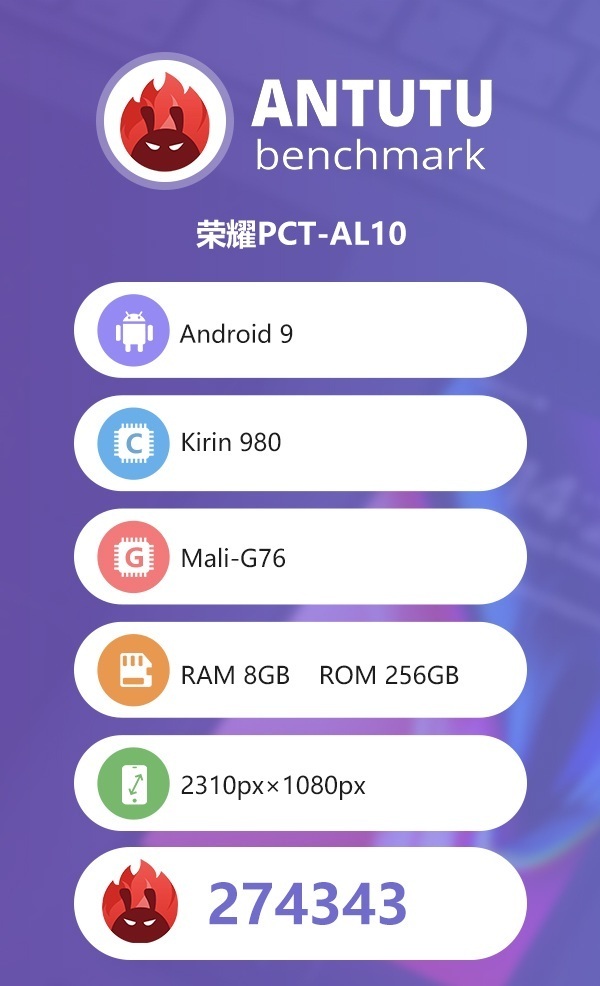
Based on Antutu’s report, the Huawei Honor V20 would feature a Kirin 980 SoC, 8GB of RAM and 256GB of internal storage. Furthermore, the Huawei Honor V20 would carry PCT-AL10 as its model number along with a 48MP IMX 586 camera sensor to take some crazy sharp pictures. Regarding the display, we’re looking at a 2310 x 1080 display with the display size remaining a mystery for now.

The alleged Huawei Honor V20 scored over 274,000 points with the help of the newly introduced Kirin 980 SoC. That’s the same 7nm SoC that powers Huawei’s flagship phablet, the Huawei Mate 20 and Mate 20 Pro.

Now that the specs are pretty much confirmed, we have a pretty good idea what the Huawei Honor V20 is all about. Huawei has already teased that they would be unveiling the device on January the 22nd, 2019, featuring some credible features and a whole lot of oomph for the upper mid-range market with a speculated sub-$500 price tag.

Competition in the upper-mid-range market has traditionally been dominated by the likes of Xiaomi and OnePlus. Considering how tough the competition has become, we’d be intrigued to see what types of tricks the Huawei Honor V20 would come with when it launches next month.

Samsung’s Fast-Charging Tech Poised To Offer Speedier Charges, Rumors Suggest

0

2018 played an immense role in reminding manufacturers how important battery sizes are. With devices now featuring 4000mAh batteries as sort of a standard now, fast-charging tech requires a few revamps and it seems like Samsung may have just realized it. Prime examples that stood out this year were the Huawei Mate 20/20 Pro, the Poco F1 (review), the Samsung Galaxy Note 9 (review) and more. In a tweet posted by our trusty Ice Universe, it seems like the aforementioned subject is now one of Samsung’s priorities now that we’re about to sail into 2019.

Fast-Charging tech is needed more than ever nowadays. Back then when Oppo and a few companies introduced the technology, no a lot of consumers were amused by the tech. As batteries enlarge, eventually increasing charging times, manufacturers caught onto the fact and begun including the technology with Qualcomm taking responsibility for devices powered by its SoCs while others took their own way.

Samsung smartphone 15w charging will become history… said Ice Universe via Twitter

While no hints were revealed in the post, what’s being implied is pretty clear. You see, Samsung’s fast-charging tech hasn’t been the best in the industry. With Oppo leading the charge by pushing 40W down supported devices with its SuperVooc technology. And Oppo’s fast-charging tech is no joke, that’s for sure. Featuring a 3730mAh battery, the Oppo Find X charges its large battery in less than 35 minutes. That’s about a quarter of the time it takes to fill in a 3730mAh battery compared to other major OEMs with their 15W power delivery.

If Samsung does manage to do something major, it’d better be worth it. Qualcomm’s Quick Charge 5.0 technology has also been poised recently suggesting that it would be able to push 32W of charge. That’s a 77% improvement. Whether Samsung plans to reach Qualcomm’s levels or if they plan to improve charging times has to be respected, after all, they need to make the Galaxy S10 revolutionary, don’t they?

Spider-Man PS4 Finally Gets The Raimi Suit From 2002

0

Marvel’s Spider-Man has been a sensation on the PS4. Developed by Insomniac games the title received immense attention and much deserved when it was first showcased at E3. As we all know that Sony has a soft spot for its exclusives and never disappoints fans with their support. Recently they announced a set of new wearable costumes for Peter Parker featuring the Spider-verse suit as well as the iron suit but fans were definitely not happy.

In actuality, Spider-Man fans all wanted Raimi’s version of the suit which was featured in the trilogy of Spiderman movies in the early 2000s. With the whole internet exploding over the cause, Insomniac had nothing but to act and act quickly and so they did. Today Insomniac games along with Marvel Studios support released the Raimi’s suit taking back players to 2002. The suit itself resembles the Spider-Man played by Tobey Maguire in the trilogy. Players who have purchased the game will now be able to unlock the classic suit for free starting today.

Given how the Developers reacted to the situation is definitely credible and is clear that they will definitely keep on adding new content to the franchise. Sony planning on shifting towards the PS Now service is also a factor in which we may very well see newer titles added.

CS: GO Winter Update Release Brings New Medals & An Old Classic Map

0

The holiday season is here and Valve has once again decided to dress up CS: GO for the occasion. The new update brings all sorts of fun and playful experiences along with some major announcements. Recently Valve has been paying extra attention towards the long-neglected title with the panorama update and then the Danger Zone update. It is clear that Valve wants the game to be relevant in the age of PUBG, Fortnite and Rainbow Six Seige. The game went free after the Danger Zone update and now players can enjoy the Non-Prime experience without paying a single penny.
The new update brings warm clothes and ugly winter sweaters for the chickens and throwable snowballs in classic modes.  Moreover, the classic Freeze frame wishing you the best is back with Militia available in classic modes. With the update, Valve has also announced 10 Year Veteran Coins for those enthusiasts who have been part of the community for over 10 years. To receive the coin users must have a steam account in good standing and must have owned any Counter-Strike title for over 10 years. Furthermore, as the year approaches an end, Valve has also introduced new yearly service medals for players who complete a lap of over 40 private ranks. The new medals will be awarded starting January 1st, 2019. 

As a whole, it is certain that developers are actually trying to polish the game and bringing new content however we still haven’t heard about a new operation yet. The update also brings substantial improvements for AMD and Intel GPUs.

Xiaomi Mi Play Teasers Are Here – To Announced On Dec 24th

0

Xiaomi has done an incredible job this year. Despite the incredible competition that has been mounting on itself for a while now, Xiaomi is in no way planning to slow down with their releases. In a teaser released today, it seems like Xiaomi is planning to showcase a new device dubbed as the Mi Play later this month.

There isn’t a whole lot Xiaomi is teasing here apart for some blatant images of the device in a series of advertising materials. Dubbed as the Mi Play, this new device from Xiaomi does seem to be a device that Xiaomi could be releasing just to combat Huawei’s Honor Play with its naming scheme.

However, given that the Poco F1 is the one that’s busy with the Honor Play, it seems unlikely, especially after China’s TENAA confirmed that the Mi Play is indeed a phone that would not pack a Snapdragon 845 SoC. Digging further into TENAA’s report, the Mi Play would pack an unknown 2.3GHz octa-core processor along paired either 3GB, 4GB or 6GB of RAM. Furthermore, the Mi Play is also expected to pack a 2900 mAh battery along with a 5.84-inch 2280 x 1080 display.

What’s special though is that it seems like Xiaomi could be ditching the large notch they’ve come to adopt this year, and instead, could be going for a simple notch, just like the one found on the Essential Phone.

Given the specifications, it seems like the device would most likely target Realme’s 2 Pro and Asus’s new Zenfone Max Pro 2 and would most likely feature a Snapdragon 600 series SoC, which one, that is yet to be seen as it doesn’t seem to line up with any SoCs from Snapdragon.

If the leaks and data seem to line up, we’re expecting the Xiaomi Mi Play to be released for $240 as that’s where Asus and Realme seem to have found their sweet spot.

Galaxy S10’s Protective Film Shows Thinner Borders & An Even Smaller Camera Hole

0

The Galaxy S10 is to be announced by Samsung early next year and until now, we have learnt a lot about the device. Apart from the amazing 5G worthy internals of the S10 and the fact that the flagship will be available in three variants with different camera setups, the display has caught the eye of many.

Source: Ice Universe

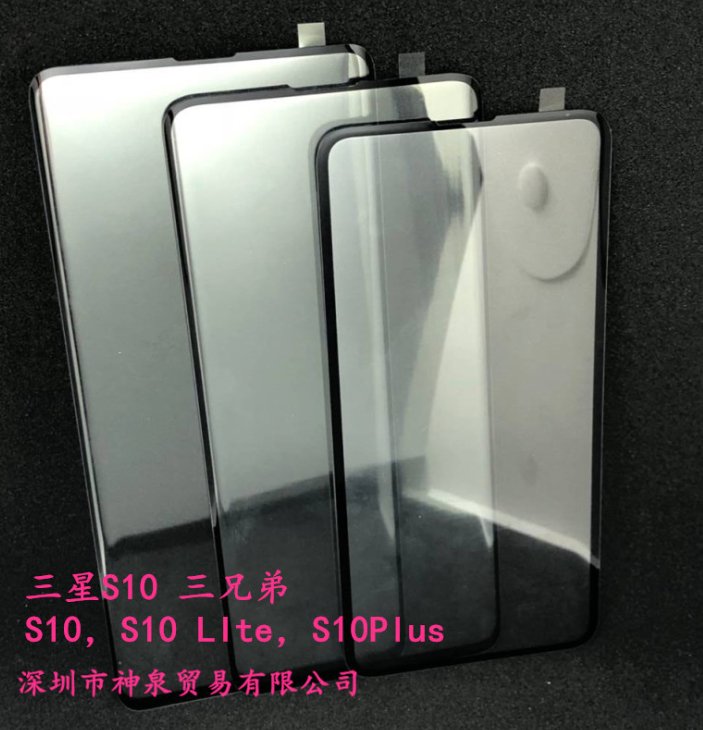
In the past, we have talked a lot about the new “Infinity-O” technology by Samsung and how they managed to pull it off with the Galaxy A8s. Ice Universe once again managed to get hold of what seems to be the protective film for the upcoming Galaxy S10s. The film proves to be a definite upgrade from the A8s and we expect Samsung to refine the software experience as well. Overall the bezels are much slimmer and better looking while the camera hole is much smaller than the A8s.

The selfie camera has also shifted its place towards the top right corner and the footprint of the device will most certainly be maintained. Given the fact how 5G seems to be the next most awaited tech for 2019. Samsung will definitely have an edge over the other competitors with embracing it early next year.  It is clear that Samsung will definitely want to step up their game in terms of sales and reliability since the Chinese brands have been very successful even outside of Asia. Given how the smartphone markets are progressing it is just a matter of time that they’ll surpass the old players sooner than anyone might think.

One of the most recent hurdles for the newcomers has been the hardware production, Huawei, on the other hand, makes its own Kirin chips so the budget Huawei devices have already fixed the problem but with manufacturers like Xiaomi, Oppo and many other we may very well see poor interaction between the software and the hardware departments.

Oppo’s New Realme Sub-Brand Is Now The Fastest Growing Brand In Malaysia

0

Oh boy does Xiaomi have some homework to complete? 2018 has been an amazing year for smartphones, without a doubt. We’ve seen many falls and many rises throughout the course of 2018 and without a doubt, Oppo’s new sub-brand Realme has to be one of the biggest rises this year.

For those of you who don’t know, Realme is one of Oppo’s latest sub-brand that focuses on the mid-range market solely as OnePlus and Oppo itself compete for the upper mid-range and high-end market.

As noted in a press release sent to us, the Realme brand has seen immense success over the past two months as it climbs the mid-range ladders in the mid-range market, a market that’s dominated by the likes of Asus and Xiaomi so far. Realme’s presence so far has been driven by e-commerce sales and it seems like the brand would continue to expand its presence in Malaysia really soon.

Across several e-commerce sites such as Lazada and Shopee, Realme has consistently been the best-selling brand in Malaysia so far and also notes that it expects to see year-over-year growth of 11% over the next year. While specific numbers weren’t released, both, Lazada and Shopee had Realme on their homepages earlier this week to commemorate the launch of the brand in Malaysia.

Realme began its run in Malaysia with the help of three enticing devices, namely, the Realme 2, Realme 2 Pro and the Realme C1, each one catering a very specific customer with prices ranging from RM 449 (US $107) to RM 999 ( US $239 ) with a fairly decent range of hardware.

The Realme 2 Pro packs a Snapdragon 660 SoC along with up to 8GB of RAM and 128GB of internal storage. Compare that to Xiaomi’s offerings such as the Mi A2 and the Xiaomi Redmi Note 5 and you know where this is going. Furthermore, both the Realme 2 and Realme 2 Pro borrow the notch found on the OnePlus 6T. Pair that with a large beautiful display and a decent set of internals and Realme has a winner, at least on paper.

Given how well Realme has integrated into the Malaysian market over the past two months is definitely enticing to see, especially given how well the brand has been in the making for a while. There’s no doubt that the executives at Realme did their homework as Xiaomi had also released a huge bomb a while ago, the so-called “flagship-killer killer” Poco F1 (review).

Given how well these phones are priced and now that Asus has also launched their take on the mid-range market with the Asus Zenfone Max Pro M2, the competition is about to get a whole lot more heated.

The New Huawei Nova 4 Features A 48MP Triple Camera Setup & A Punch-Hole Embedded Selfie Camera For $490

0

There’s no doubt that the mid-range market is getting crowded, but it seems like that is turning into a good thing as Huawei has finally announced the Huawei Nova 4 after weeks of teases and leaks.

Huawei Nova 4 Announced  – Features a 48MP shooter and a punch-hole selfie camera

Spotted by Android Authority first, the new Huawei Nova 4 features some incredible internals for its supposedly mid-range price tag. Beginning with the specs, the Huawei Nova 4 packs Huawei’s last-gen Kirin 970 flagship SoC, 8GB RAM and 128GB of internal storage. In addition to that, the new Huawei Nova 4 features a triple camera setup at its rear consisting of either a 48MP + 16MP + 2MP shooter or either a 20MP + 16MP + 2MP sensor at its rear.

However, the spec sheet doesn’t dictate the full story yet as not only does the Huawei Nova 4 come with a 48MP shooter, but it also comes with a 25MP punch-hole embedded selfie camera, similar to the one found on the recently launched Samsung Galaxy A8S.

Being a Huawei device by heart, Huawei has included a ton of AI gimmicks throughout the phone, most notably in the camera app. EIS-enabled 4K HDR video recording is present with the exception of OIS or 60FPS video recording. Furthermore, the Huawei Nova 4 comes with a rear-mounted fingerprint sensor, a 3.5mm headphone jack, a 3750 mAh battery, as well as a 6.4-inch IPS FHD+ display.

While the device is attractive, it’s worth noting that the Kirin 970 found in the Nova 4 is a last-gen flagship SoC from Huawei’s in-house labs. So do not expect incredible performance with the aging chip as Huawei rolls out the Mate 20 and Mate 20 Pro across the globe packing the Kirin 980.

Huawei Nova 4’s Pricing, Colors & Availability

Regarding pricing, the Huawei Nova 4 would retail in two variants, each of the two differentiating another with their camera sets while RAM and storage capacity remains as a standard between the two variants. ¥ 3399 ($492) is the price Huawei has set for the higher end of the two, with the 20MP + 16MP + 2MP shooter’s price yet to be confirmed.

However, if you do care about being trendy, the Huawei Nova 4 comes in four attractive colors, namely, honey red, blue, white, and black.

Regarding availability, the device would most likely launch in January as the device would begin to roll out in China later this month. As the ban on Huawei’s products continues to be enforced in certain regions, we’re pretty sure that the device would not end up in the North American regions anytime soon, that is, officially. However, given that Huawei has a decent market share that comes in from Asia itself, the device, as mentioned before, would most likely launch in January.

Given the price that Huawei is asking for the device, the device is simply butting heads with the likes of the now-discounted Samsung Galaxy S9, the now-discounted OnePlus 6 and Xiaomi’s Mi 8 lineup ( Mi 8, Mi 8 Explorer & Mi 8 Pro), all of which offer a better SoC.

Here’s The First Renders Of Huawei’s Next Flagship, the Huawei P30 Pro

0

It seems like the first renders of Huawei’s next flagship, the Huawei P30 Pro has just dropped and it seems like Huawei isn’t done yet. The first set of renders are coming from our trusty Ben Geskin over at Twitter showcasing what the P30 Pro may look like.

The renders showcased by Ben Geskin showcase a lot of the classy Huawei elements that you would come to expect from a Huawei device. From the flashy design to the attractive color gradient. However, what we didn’t see coming is a teardrop notch. Renders released by the leakster indicate Huawei’s plans to go with a waterdrop notch with the Huawei P30 Pro. In addition to that, the renders also suggest that the Huawei P30 Pro would feature a quad-camera setup at its back again next year.

For a bit of context, last year’s Huawei P20 Pro came with a Kirin 970 SoC, a 40MP + 20MP + 8MP rear camera setup, 8GB RAM, up to 256GB of internal storage and a 4000mAh battery.

Given that last year’s Huawei P20 Pro completely bamboozled Huawei’s competitors for its incredible camera performance and attractive aesthetics, we’re pretty sure that the P30 family of devices would only improve on their formula as Huawei and its fleet of Chinese competitors continue to pressurize Apple and Samsung’s market share.

Additional leaks regarding the Huawei Honor V20 and Huawei Nova 4 have also surfaced suggesting Huawei’s plans to amp that even further next year with a 48MP main sensor. Leaks regarding the aforementioned devices also seem to be dictating a new design language from Huawei too with the help of a punch-hole camera design that embeds the selfie camera within the display itself.

While speculating the internals for next year’s Huawei P30 Pro aren’t that hard, there’s a lot of debate murmuring around the P30 Pro suggesting that Huawei could be planning to release a new SoC with 5G capabilities while at the same time utilize the Kirin 980 found in the Huawei Mate 20 series and Honor devices for upcoming budget-oriented devices. These set of rumors come in after alleged leaks suggested the development of a new Huawei Hisilicon Kirin 990 appeared online to keep up with the whole 5G trend that’s set to boom devices releasing throughout 2019.