Nokia ever since the revival by HMD Global has been making dents in the modern smartphone world. The Nokia brand has pretty much covered every corner of the smartphone market from the premium phones to the bare budget devices. The Nokia 1 smartphone recently became the cheapest Android Go device in India dethroning Redmi Go which is definitely worth praising.
As time moves on, Nokia plans on making a move towards Europe. European markets have always been beneficial to manufacturers and Nokia plans on regaining lost glory in the region. Recently the Nokia 1 Plus has made its way in the UK markets. The Nokia 1 Plus is a budget oriented device meant to host the bare essential features with a clean and reliable experience. With a very impressive price of just £90.
Considering the fact how Chinese manufacturers have taken over the budget department of smartphones, we barely see any newcomers to the market especially the under $100 range. Moreover, all the phones offer a very signature device with shiny and lush features with a crowded UI experience. Nokia here finds its niche in simplicity and elegance. Running stock Android the phone achieves just that and offers a sleek and stealthy look.
The phone does come in a few colour options like Black, Blue and Red with fair internals. The phone features the bare essential two cameras, one on the front and one on the back with a standard LCD display running the latest Android Go software. The phone itself is currently available at Carphone Warehouse and would make its way into other sites for folks to start ordering pretty soon.
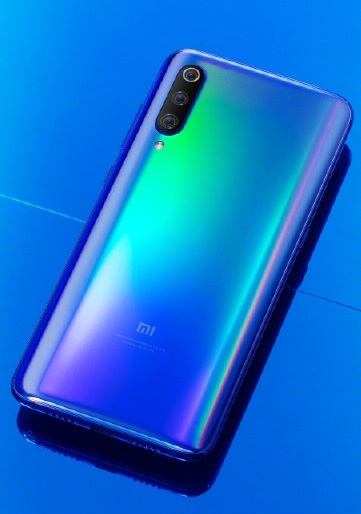
Xiaomi let a ton of people down shortly after the revelation of the Mi 9 lineup. Enthusiasts and techies alike were bummed to find out that Xiaomi had halted the sale of the Mi 9 SE for quite a while due to slow production. However, in a recent tweet posted by the folks over at Xiaomi, it seems like Xiaomi is ready to launch the Mi 9 SE in the international market.
The Xiaomi Mi 9 SE is Xiaomi’s latest entry that was supposedly launching alongside its flagship cousin the Mi 9. For folks who couldn’t afford the Xiaomi Mi 9, the Mi 9 SE was an incredible getaway for folks who wanted the best of Xiaomi with a few compromises to make up for its price.
The Xiaomi Mi 9 SE like its other cousins and rivals features the usual 48MP sensor on its back. What made the Mi 9 SE special at the time was the fact that the device featured a trio of cameras on its back, with the other two sensors being 8MP and 13MP on the megapixel scale. With the 48MP being the main camera, Xiaomi reserved the 8MP and 13MP sensors for telephoto and ultra-wide shots, respectively.
Other features that you would be missing out on with the Mi 9 SE include the headphone jack, the newly-introduced 20W wireless charging from the Mi 9, and the Snapdragon 855 SoC. Other than that, the device looks incredibly compelling, especially when you consider that the Mi 9 SE would retail for $299.
What’s concerning at this moment for the Xiaomi Mi 9 SE has to be the fact that it is late to the party, and since its initial announcement, Xiaomi’s Redmi Note 7 and Note 7 Pro have completely obliterated the same space the Mi 9 SE is trying to fit in, that too with the headphone jack for savage purposes if you go for the Note 7.
Regarding where Xiaomi plans to launch the Mi 9 SE remains a mystery. However, I personally wouldn’t be shocked if the device launches in India.
Lenovo is a smartphone brand which has been chasing the budget orientation of the smartphone market for quite some time. Although the brand has made some credible progress in the past, Chinese manufacturers flew right past it both in innovation and accessibility. The latest smartphone from the manufacturer is dubbed to be the Lenovo Z6 Pro.
First spotted on a Chinese website, the promotional posters of the phone have surfaced and show a very recognizable smartphone with a very mainstream set of features. The exterior of the phone looks extremely identical to the Huawei phones, in fact, the camera arrangement is identical as well. The phone is to house four rear-facing cameras inclusive of the depth sensor situated below the triple camera module. The colour of the phone is a very mesmerizing red on a black gradient which again resembles a lot to what a Huawei phone might have.
As for the front of the device, little to nothing is known but we speculate that the phone would host a teardrop notch considering its other features. Moreover, the phone does seem to house a headphone jack for enthusiasts. No fingerprint sensor was spotted at the back of the device and it is very probable that the phone would house an under display fingerprint sensor.
As for the camera features, the device hosts a 48MP standard shooter with a normal wavelength while the other sensor is perhaps the wide-angle paired with a telephoto lens. The phone considering its specifications seems to hit the mid-range market with a very Huawei like look. The pricing and availability of the phone is yet unknown but the phone is likely to hit Asian markets as a star contender with aims of taking on Xiaomi, Huawei and Oppo.
Motorola’s upcoming smartphone was recently teased a couple of times and shown to host quite a few unique features. The device’s oute body seemed very streamlined yet authentic and the phone was to host a whopping 4 camera setup on the back. Fast things forward, courtesy of Evan Blass the names of various different variants of the Motorola flagship have been confirmed.
The device is confirmed to be named after the “Motorola One” brand and a total of four variants would ship globally namely, Motorola One Power, Motorola One Vision, Motorola One Action. As ridiculous as the names sound, the news comes from an authentic source and Motorola seems to plan on spicing things up this year. With competition levelling up by a significant margin the brand hopes to keep up with the pace by releasing various variants focussing on different aspects.
Our speculation says that Motorola would definitely want to limit its latest arsenal for its 5G capabilities. Given how big of a deal 5G has become, an external module slapped on to any Moto device would pretty much defeat its purpose. We think that one of the variants would be exclusive to 5G and would completely harness the power of 5G. As for the other devices, differences in camera sensors and camera technology could be expected.
Given how well smartphone cameras are performing these days, I won’t be surprised if Motorola slaps a minimalistic camera setup on the lower end variant. However, with great variants comes great responsibility and if all four of the devices are true then Motorola would need to provide the best customer support. Having four phones released simultaneously is never easy and only time will tell how well Motorola deals with the obstacle.
OnePlus had begun teasing their upcoming OnePlus 7 series. However, while they do, the beans from the OnePlus 7 family have just been spilled thanks to two leakers who have completely shredded the OnePlus 7.
According to the first leaker, OnLeaks, the upcoming OnePlus 7 family is going to consist of two devices, the OnePlus 7 and the OnePlus 7 Pro. The OnePlus 7 on one hand is said to feature a 6.4-inch flat display featuring a water-drop notch display and looks eerily similar to the current OnePlus 6T. Furthermore, the leaker suggests that the OnePlus 7 woud come with a dual camera setup on its back featuring at least a single 48MP sensor as its primary.
Contrary to the OnePlus 7, the OnePlus 7 Pro is where the magic happens this year. According to the same leaker, the OnePlus 7 Pro would come with a 6.64-inch display under the hood, featuring curved sides, a triple-camera setup on its rear, and a pop-up camera up front to keep things clear. Furthermore, like the OnePlus 7, the triple-camera setup would consist of at least a single 48MP sensor on its back, while the other two cameras, the ultra-wide and telephoto shooters yet to have their megapixel count leak.
#OnePlus May 14th launch event: #OnePlus7 ≈ 6.4″ flat display / waterdrop notch front camera / dual rear camera with 48MP as primary #OnePlus7Pro ≈ 6.64″ curved display / pop-up front camera / triple rear camera with 48MP as primary Telephoto + Ultra Wide #OnePlus7PRO5G
via @OnLeaks
However, Ishan Agarwal, the second leaker in the scene has the major leaks regarding the upcoming OnePlus 7 Pro. According to the leaker, the OnePlus 7 Pro would feature a 90Hz Quad HD+ display this year, a major bump from the long-standing Full HD resolutions brands like Xiaomi and OnePlus have been sticking to. He then adds that the OnePlus 7 Pro would come with a 4000mAh battery, the newly-introduced 30W warp charge, a triple-camera setup, and a supposedly dual speaker stereo setup.
Exclusive for @AndroidCentral! Some details about the OnePlus 7 Pro: -Quad HD+ Super AMOLED “90hz” Display -USB 3.1 -WARP Charge at 30W, 4000mAH Battery -Dual Speakers -Triple Camera Setup (Wide Angle and Telephoto) OnePlus7Pro #OnePlus7
said Ishan Agarwal via Twitter
He then further added fuel to the hype by announcing that the OnePlus 7 and OnePlus 7 Pro would be launching on May the 14th, simultaneously in India and USA at the same time.
And while 90Hz does seem to be a far stretch, we’re quite confident about the leaks now that OnePlus CEO, Pete Lau, has jumped onto the bandwagon, describing the OnePlus 7 as fast and smooth.
Regarding specifications, no one has come out with concrete information regarding the OnePlus 7 lineup. However, it’s anyone’s guess at this point given the company’s strong history of sticking with flagship-grade hardware. We’re expecting the OnePlus 7 and the OnePlus 7 Pro to come with the latest and greatest Snapdragon 855 SoC, 8GB of RAM, at least 128GB of internal storage, and more.
Regarding pricing, given the new updates and additions, we’re sure that OnePlus isn’t going to mind increasing the prices of the OnePlus 7 and OnePlus 7 Pro. Given where OnePlus has rooted from, the OnePlus 7 and OnePlus 7 Pro would be the nail in the coffin if the base OnePlus 7 comes with any price hikes. In OnePlus’s defense though, the OnePlus 7 Pro seems to be the star of the show, and given the additions, we wouldn’t be surprised to see of the OnePlus 7 Pro comes with featuring a $699 price tag out of the blue.
Microsoft has just announced the Xbox One S All-Digital Edition, the console no has been excited for in a while. Following a series of leaks, Microsoft has finally delivered on the leaks.
The common question with any launch typically goes along the lines of, “What’s new in this {insert product name here}…”. However, it seems like Microsoft seems to be saying, nothing! The new Xbox One S All-Digital Edition is a re-incarnation of the original Xbox One S without a disc drive, and that’s about it. I mean, just look as the announcement trailer.
https://www.youtube.com/watch?v=yBDSMNE3_oQ
The new disc-less Xbox One S does come with its advantages though. The new Xbox One S comes with 1TB of internal storage, and that’s about it. And if you’re one of the early adopters of the console, the console comes bundled with three games; Minecraft, Sea Of Thieves, and the last-gen Forza Horizon 3.
With the announcement of the console, Microsoft is finally comfortable bumping up the price of the Xbox One S to $299 again, a console that once sold for $249 before Microsoft dropped the Xbox One S All-Digital Edition in its place. The console is set to hit markets on May the 7th in the USA and Europe. Pre-orders for the console are currently open if you’re into such a console.
Huawei seems to be developing what seemed to be dubbed as the Huawei 20 and the Huawei 20 Pro. With both devices coming out of nowhere, it seems like Huawei is planning to fill in as many gaps as they could in the high-end market as recent concept renders of the Huawei 20 Pro emerge.
Sourced from Weibo, it seems like the Huawei Honor 20 Pro would resemble the Huawei P30 Pro on its back, featuring a triple camera sensor and a TOF sensor. What’s also worth noting is that the newly released renders also showcase what seems to be a new color that may be exclusive to the 20 Pro if it ever comes to life and the fact that one of the camera sensors has a square-like border around it, hinting the inclusion of a periscope zoom camera.
And while these are just renders, it surely seems to spark some joy about a mid-range device featuring a triple camera setup borrowed from the P30 lineup hitting the mid-range market. Regardless of the internals, it would be incredible to see if Huawei manages to bring some of those features to the Huawei Honor 20 and Honor 20 Pro.
If the rumors are true, given Huawei Honor’s pricing history, the device could very well land into the $400-$550 price bracket which is incredible if it does. But the question is, does Huawei plan to use the RYYB camera sensors here too?
The youtuber, Pixel Peeper has uploaded the picture comparison between the two S10s meant for different markets and the results are definitely staggering. The contrast is visible even by an amateur and both the phones seem to produce two different images.
The Samsung Galaxy S10 is out for quite some time and the device immediately became the centre of attention for many. Some even claim it to be the benchmark device of the year and for good reason. The phone offers a very balanced set of features which for the most part are improved upon quite significantly. The camera department of the phone is definitely one of its main selling points and the phone gives a satisfactory performance overall.
One of the features of Samsung’s flagships is the fact that not all Galaxy S10s are created equal. The Galaxy S10 is generally split into two mainly differentiated by the SoC it rocks. Samsung is undoubtedly a perfectionist when it comes to hardware manufacturing and has built the Exynos SoC. Apparently the Exynos chip while being optimized specifically for the S10 isn’t feasible for various markets and here’s when the Snapdragon 845 SoC comes into play.
Now despite Samsung pulling every string to match devices rocking the different SoCs to perform equally and identically, both the SoCs differ greatly. Apart from battery life, raw performance and whatnot, photography is a feature which even Samsung cannot control and the contrast between an Exynos-powered S10 and a Snapdragon-powered S10 is staggering.
First up is the front facing camera, the Exynos powered phone houses an isocell Samsung sensor while the other hosts a Sony IMX sensor. The results though are similar at the first glance. As we take a closer look, the Sony sensor seems to do a better job on shadows and sharpness the image is far more crisp on it. The isocell sensor holds up well but the image is more buffed up and the edges aren’t apparent. The colour toning on the Samsung sensor is far more vivid and vibrant.
The triple camera setup on the back of both the S10s are identical and the sensors are identical as well. The images, however, differ and differ unusually. The Snapdragon shines the brightest when both the phones are compared in rear-facing photography it just shows the growth of Qualcomm’s image processing technology. Despite various features provided by the Exynos processor, the Snapdragon leaves it in the dust and produces spectacular and consistent photographs. The image taken from any of the sensors is very well balanced, exposed to perfection and most importantly sharp. The isocell sensor, on the other hand, overexposes a bit and the colour reproduction is definitely lacking.
It clearly shows how much a change in SoC could bring in photography and most importantly image processing. The Exynos is clearly behind the Snapdragon 845 and it just shows how much stuff there is for Samsung to learn in this particular department.
This year is off to a great start, we’re almost halfway through and major manufacturers have already brought in their flagships for the year. From Samsung, Huawei to all the way up to Xiaomi and Nokia, each and every single device has brought in something new to the table and is true to a unique signature. Amidst all the similarities, major smartphones have chosen a certain aspect of their device and improved upon it significantly this time around.
2019 not only spices things up in the innovation department but also seems to spice up the approach of smartphone manufacturers. Gone are the days when everyone would hop on the bandwagon to pursue a singular feature of their device like the display, battery life or whatever seemed right. As late as 2018 we saw manufacturers hopping on the notch bandwagon trying their best to rectify borders and bezels of their flagships. Some even came up with direct solutions to the notch like the pop-up design by Oppo and the slider mechanism from Xiaomi.
The Contrast Of Smartphones From 2018 & 2019
However, as this year proceeds one thing stood out of the inevitable which by far couldnt be neglected. It is the fact that despite various trends circling around the media space it holds very little influence especially in the more premium smartphone department. It seems that those days remain no more when manufacturers would directly compete working on innovation in the same sector as the other and boast on their progress. 2019 brings various smartphones with their own footprint unique to any other and more specifically a unique selling point.
With the exception of a couple of homologous features pretty much everything is changing amongst smartphones. For instance, the Nokia 9 hosts a five-camera setup and that bizarre setup act as its main selling point. Now, Huawei’s P30 Pro which has a very similar approach offers a triple camera set up at the back but the approach here is completely opposite of Nokia. Instead of relying on multiple sensors to bring out the best image, Huawei presents diverse sensors with a revamped colour sensing technology namely “RYYB”. Now considering the Galaxy S10 which has been the most awaited smartphone of the year, it offers a punch hole display which in theory should become the next sensation for 2019 but it actually hasnt.
We’ve seen barely a couple of devices mimic the design that too out of competition while most of the regular flagships stick with the teardrop notch. This fact doesnt mean that competitors have stopped competiting but it just shows that they’ve learnt over time. This means that brands have learnt to take a more tactical approach instead of going head to head with the tech giants. This feature alone has allowed Chinese smartphone manufacturers to take over half the smartphone markets especially in the budget department.
As for the consumer, this change in gameplay has proved effective. Prices for mid-rangers have come down significantly with better support and reliability. Moreover, this change in plan hosts a ton more potential for innovations to proceed and new innovations to cater to. This new gameplan has improved competition, offered diversity and most importantly kept enthusiasts busy throughout the year.
Conclusion
In conclussion, this change of pace is directly proportional to innoavtion and progress which for both the consumer and the manufacturer is the most important aspect of a device. This has also allowed brands to experiment more with their smartphones. Samsung for instance has chosen the Galaxy A series to act as a lab rat which first introduces any major sort of change in technology and then closely follows the feedback on the devices. The positive feats of the device later on progress towards the Galaxy S series which Samsung likes to maintain in a perfectionist manner. In coming days we expect more and more manufacturers to start experimenting more and more since the tides have turned and there isnt really much to lose. Xiaomi as a matter of fact has been extremely diverse recenty. The Chinese brand has covered almost every corner of the smartphone market except the U.S and is definitely not going to stop any time soon. Similarly we hope that brands do more towards the progress of innovation for the betterment for both their and our future.
Google has just updated the Google Store, more specifically, the US version of their site. On their site, Google seems to be teasing a new device.
And although Google seems to be showcasing what teasers from the Avengers in their new series of hilarious ads, we can’t bother to suggest that this may actually be related to the launch of the Pixel 3A and Pixel 3A XL, the two devices that have been leaking since late last year.
On May 7, something big is coming to the Pixel universe.
The Google Store page reads
The two devices are said to be Google’s first take on the mid-range market and would be the devices that would revive Google’s promise of delivering incredible devices for mid-range prices from the Nexus 5 days. Other than that, Google has managed to keep the Pixel 3A and Pixel 3A XL quite concealed unlike the Pixel 3 days.
Additional speculations from our end of a string are suggesting that Google’s Pixel 3A and Pixel 3A XL would be partnership Google would forge with its newly-forged partner, Xiaomi.
Now that we’re less than three weeks away from the launch of a potentially new Google-branded smartphone, we can’t wait to see what Google has in store for this launch.
Apparently, it seems like Xiaomi isn’t done with their launches yet. Following the launch of the Redmi 7 and Redmi Note 7 lineup, it seems like the next device making its way to Xiaomi’s lineup could be the Mi A3 / Mi 9X. Images alleging to be of the a Redmi device have surfaced on the internet, leaking what we could expect from the device.
According to the leaked image, it seems like the device features yet again a triple camera setup on the back. However, the shocking part of the leak has to lie in the CPU, battery, and camera department where the device seems to be featuring a headphone jack, a 4000mAh battery, a Snapdragon 730 SoC and a pop-up camera. There’s no information what the megapixel count from the front camera looks like. However, what we could confirm based on the image is that the device in the image features a 48MP shooter, a 13MP shooter, as well as an 8MP shooter on its rear.
The leak alleges that the image seems to have originated from a Redmi-branded phone. However, that seems unlikely given how extensively Xiaomi has filled in the gaps there. If it could be anything, it has to be the Mi 9X if the leaks are indeed true, which would also suggest that the hardware specs may also be the specs of the Mi A3, Xiaomi’s upcoming Android One device.
There’s no telling if the leak is true. I’m personally not confident in the leak given how heavily edited the images published are. However, then again, recent leaks have suggested the active development of Xiaomi’s upcoming Mi A3 lineup. Whether this lines up with them or not is something only the future could tell. For now, we would say, take the leak with “a ton of salt”.
If you’re tired of Panorama UI, there are a number of unofficial ways to spice up CSGO’s new Panorama. On the legacy UI that CSGO had going on before the Panorama UI update, players traditionally kept customizations limited to the fonts of the UI. However, soon after the announcement of Panorama UI, players found themselves going over a lengthy and complicated process to install custom fonts and backgrounds in Panorama. However, it seems like a kind soul has managed to develop a simple application to handle fonts in CSGO for you.
The latest program dubbed as CS:GO Panorama Font Changer aims to do exactly as its name suggests. The program is available on GitHub to download, so pick it up if you plan to add some more glamour to your CSGO experience. Here’s how you could install your custom fonts.
Pre-requisites
CS:GO Font Changer
.NET Framework 4.5+
Your font of choice in TrueType (.ttf) format
Steps On How To Install Your Custom Fonts
Upon extracting the file downloaded from GitHub, all you have to do is launch the program. We would recommend you to launch the program as admin.
Once that’s done, simply locate the folder where CS:GO is installed. If you haven’t installed CSGO in a custom directory, navigate over to C:\Program Files (x86)\Steam\steamapps\common\Counter-Strike Global Offensive and click “Ok” to finalize your directory.
Next, install your custom font by double-clicking on it and then clicking on “Install”
Once that’s done, come back to CSGO Panorama Font Changer and navigate to the ttf font file you just installed earlier. Select it and click on “OK” to finalize your selection. Once that’s done, you’ll see a preview of the font in the box below.
Next, click on install. If you do encounter any errors, simply skip them.
If you do plan to uninstall the fonts, you could simply “Verify Files” in Steam’s properties section.
The Samsung Galaxy Note 10 is going to be one of Samsung’s most polarizing device later this year. Apart from the Galaxy Note 10’s release schedule, there isn’t much we could talk about. However, it seems like leaks regarding the Samsung Galaxy Note 10 have begun to emerge, more specifically, the Galaxy Note 10 Pro.
In one of Ice Universe’s latest tweaks, the tipster has teased the development of an additional Galaxy Note 10 variant dubbed as the Galaxy Note 10 Pro. And while the tease was as vague as a throw off in a match, it’s worth noting how much Samsung plans to expand its flagship lineup.
So far, there’s no word on how much the Galaxy Note 10 Pro would differ from the original Samsung Galaxy Note 10 or even the Galaxy S10 family. However, if it is under development, it seems like Samsung would most probably bulk it up some major improvements over the Galaxy Note 10 to make it worth it. Personally guessing, it would suggest that it may be related to 5G or even some wicked new camera technologies Samsung is planning to integrate into the phone. Whatever the case may be, it certainly shows a sign of urgency from the folks over at Samsung, probably due to how close Huawei has gotten to them lately.
Regarding specifications, we’re expecting the Samsung Galaxy Note 10 to come at with least a quad-camera setup on its back, at least on the Note 10 Pro. Furthermore, unless Qualcomm decides to launch an incremental update to the 855, we might see the Snapdragon 855 SoC paired with up to 12GB of RAM and at least 1TB of internal storage. And if that wasn’t enough, we’re expecting the 1TB of internal storage to be based on the UFS 3.0 standard given that Samsung had announced they have begun mass production of UFS 3.0 flash storage chips a while ago.
Only time would tell what improvements the Galaxy Note 10 series would bring to the table. However, if I were to drop my speculation hat on the mat, I would definitely say that the Galaxy Note 10’s even larger display would be an even bigger of a trap.
OnePlus may very well be on the verge of announcing their next major launch event for the OnePlus 7 next month. Well-known leaker, Ishan Agarwal has suggested that the Chinese company, OnePlus, could potentially be unveiling their next flagship, the OnePlus 7, along with its three variants next month.
OnePlus 7 Variants, Specifications & Release Date Leaked
OnePlus 7 Variants Leaked – May Come In A 5G Variant Too
According the leaker, the OnePlus 7 would come in three variants, the OnePlus 7, OnePlus 7 Pro, and the OnePlus 7 Pro 5G. Today, the tipster has added fuel to the burning hype by revealing the alleged reveal date for the upcoming OnePlus 7 launch does seem to be right around the corner. In a tweet, supported by the allegedly leaked OnePlus 7 Pro, he said...
BTW, I have just got the model numbers of the OnePlus 7 Variants confirmed so here they are:
GM1901,03,05 -> OnePlus 7
GM1911,13,15,17 -> OnePlus 7 Pro
GM1920 -> OnePlus 7 Pro 5G
PS: Still not 100% Sure, maybe for development only.
OnePlus 7 Release Date – Keynote Expected To Go Live From Chinese Shores
Today, he added that the OnePlus would be holding its keynote on May 14th, 2019 featuring the slogan “Go Beyond Speed”. That leaves us with one month exactly. Given the promotional posters and leaks that have been bombarding the internet so far, it seems like the device would be revealed in China this time around, an unlikely move from the company given its history. However, Ishan adds that this would also be the global launch of the device, which seems to suggest that the device would be available for purchase from OnePlus and its authorized stores on the very same day.
OnePlus 7 – Revising The Specifications & Our Speculations
Regarding specifications, we did a detailed breakdown of the OnePlus 7 Pro’s internals in the previous leak Ishan posted, including a few speculations that we threw in regarding the triple-camera setup OnePlus is allegedly going for on these new devices.
However, just to go over the general specifications as anyone’s guess, the OnePlus 7 and its lineup of devices would come with the latest Snapdragon 855 SoC paired with 8GB of memory and at least 256GB of internal storage as its highest-end option. Furthermore, on the design aspected of the device, the OnePlus 7 Pro is also expected to pack a triple camera (detailed speculations and breakdown) set up at the back, dual curved sides borrowed from the Samsung Galaxy lineup, as well as a selfie camera tucked into a pop-up mechanism that it borrowed from its sister company, Vivo.
Regarding pricing, we’re expecting yet another price hike from the folks over at OnePlus. This time, we’re expecting the base variant of the OnePlus 7 to retail for at least $579 in the US given the additional and major design changes the OnePlus 7 lineup is expected to introduce. Tag that with the fact that OnePlus 7 has the exclusivity of reigning its prices on the American market now that Huawei and Xiaomi are out of the game, it’s anyone’s guess where OnePlus is going from here on.
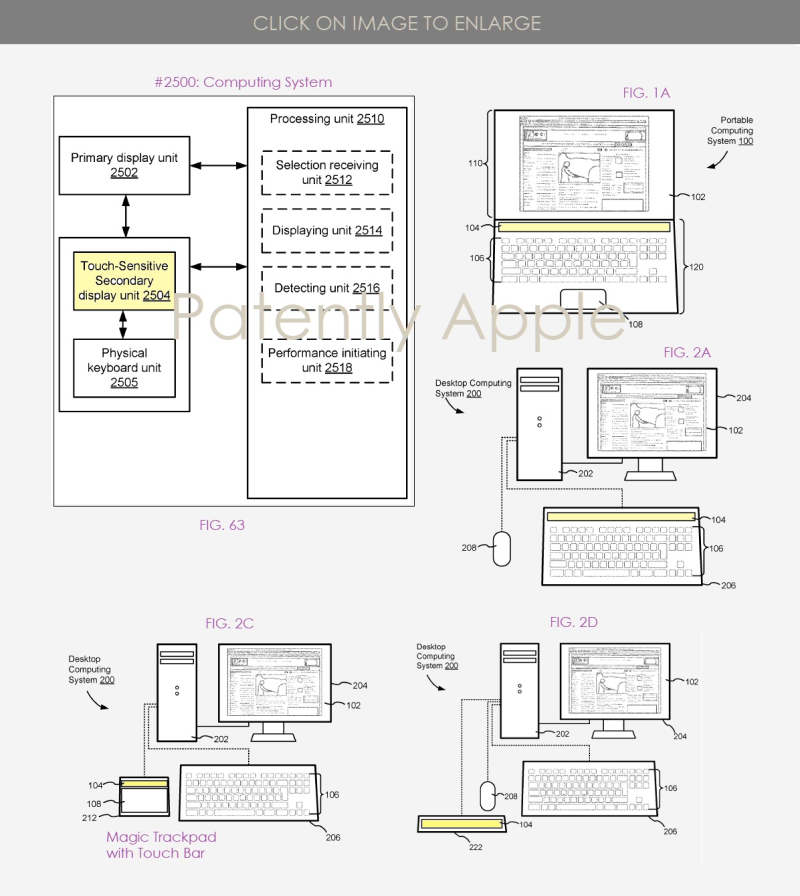
Apple’s latest patent for its upcoming products have just surfaced courtesy of guys at patentlyapple. The product designs were patented at the European patent office and show a couple of interesting factors about the upcoming devices by Apple.
Apple’s previous devices have had touch ID and the touch bar in the new MacBooks. The new patent reveals that Apple might add that touch bar in its latest iteration of the Magic Keyboard. Moreover, the patent also reveals that the new devices with the touch bar would also employ a biometric scanner most specifically a retina scanner.
Now, previous notebooks by Apple have had Touch ID support which levelled up the security on Apple devices but ever since the iPhone X, Apple’s gaze has shifted towards Face ID and the patent shows that Face ID might become a reality for upcoming desktop and notebook PCs by the brand. The Face ID feature by Apple is claimed to be a lot more effective and secure than the tradition fingerprint sensors and the company also stated that Face ID is the future of biometric security. Given how Apple behaves like a perfectionist brand, having uniformity amongst their products is inevitable.
As for the new Touch Bar, the new employed feature took the MacBook by storm and was definitely an element of excellence. Not only increasing the productivity but giving a sort of flare which is rarely held by such devices. The Magic Keyboard has been a part of Apple’s fleet for quite some time and it seems that now might be a good time for Apple to update it. The new touch bar as stated earlier would bring in uniformity and perfectionism to Apple’s fleet of devices and enthusiasts rocking desktops would be able to enjoy the complete Apple experience.
At this point in time not much is known about when the new devices would be updated while we know for a fact that the patent was actually filed way back in Q3 2017. With time we expect Apple to reveal the new features in their next event later this year and while not much could be said about the brand since it is pretty secretive about its products.
A recent study conducted by an Asian organization “Niko Partners” has just revealed the gaming aspect of the South East Asian region. The region alone makes up half the world’s population and is one of the most bustling and active places in the world. The study shows where the interests of Asian gamers lie and what draws them the most. What type of games they spend most their time on and how much they spend on their games.
The pie chart shows that a whopping 60% of South East Asian gamers are attracted or drawn towards e-sports and have a strong spot for competition and challenge. Out of all the different types of gamers about 42% fall in the Competitive Arena Gamers spending an approximate of $15 on PC games and $10 on mobile games.
E-sports has been an emerging platform and its awareness is ever growing as time passes by. More and more folks are learning about the platform and its benefits as time passes on and the Asian region which comprises of a huge chunk of gamers shows the result. With over 60% of enthusiasts somewhat inspired by esports shows that the demand and recognition for esports are growing at a steady rate and the inspiration, especially in the GSEA region, is prominent.
The study also shows that the majority of enthusiasts are aged between 12 to 23 which shows that the market itself is generally reigned by the youth with gamer spending being substantial this past couple of years. The report suggests that South East Asian gamers prefer competition, foster community and teamwork over anything else which justifies their love for esports. One thing of notice here is the fact that the GSEA region does not comprise of every South Asian country but in fact, consists of China, Indonesia, Malaysia, Philippines, Singapore, Thailand and Vietnam.
As time progresses we expect more and more players to draw towards the platform and spend more towards the cause. As the global gaming index increases at a steady rate we expect the numbers to continue growing in the future.
Asus has been a leader in the PC gaming market for more than a while. Today, the folks over at Asus have announced their first premium PC gaming chassis aimed at enthusiastic gamers featuring every single feature you could think of.
The new Asus ROG Strix Helios features three 4mm glass side panels, an incredible shape with sharp corners, RGB lighting, excellent cable management, fabric carrying handles and more. Furthermore, the Asus ROG Strix Helios features incredible RGB integration thanks to its in-house Aura Sync technology, fan dust meshes all around the case, as well as a GPU brace to keep your sagging GPU stable.
Regarding your cooling options, the Strix Helios comes with support for a 140mm triple-fan rad on top and front of the case. Continuing down its feature set, the case supports Mini-ITX, ATX, and ETX motherboards alike and comes with a PSU shroud. Coming over to connectivity and front panel of the case, the case features a 2nd-gen USB Type-C port, four USB 3.1 ports, a 3.5mm headphone, and mic jack, lighting controls, fan controls, and a large power button.
The case also comes with tabs to release the glass panels on either side as well as radiator mounts to keep everything smooth and easy.
Over at the back of the case, you have 33mm worth of width to house your cables in. And if you happen to have RGB-enabled SSDs, like the ones we’ve seen from Team Group, you could take that to the next level too with the help of Asus’s Aurasync RGB lighting, illuminating the back side of the case as well.
ROG Strix Helios
Motherboard Compatibility
EATX (up to 12” x 10.9”), ATX, Micro-ATX, Mini-ITX
I/O
1 x USB 3.1 Gen2 Type-C
4 x USB 3.1 Gen1
1 x Headphone
1 x Microphone
LED lighting control buttons
Fan speed control buttons
3.5" / 2.5" Drive Bays
2
2.5" Dive Bays
4 (up to 9)
Expansion Slots
8 x Horizontal PCIe
2 x Vertical PCIe
*Fitted bracket for two vertical GPUs
Maximum GPU Length
450 mm
Maximum CPU Cooler Height
190 mm
Maximum PSU Length
220 mm
Radiator Compatibility
Front: 120 mm, 140 mm, 240 mm, 280 mm, 360 mm, 420 mm
Top: 120 mm, 140 mm, 240 mm, 280 mm, 360 mm
Rear: 120 mm, 140 mm
Cooling Support
Front: 3 x 140 mm / 3 x 120 mm (radiator + fan thickness: Max. 90 mm)
Top: 2 x 140 mm / 3 x 120 mm (radiator + fan thickness: Max 60 mm)
Rear: 1 x 140 mm / 1 x 120 mm
Pre-installed Fans
Front: 3 x 140 mm
Rear: 1 x 140 mm
Removable Dust Filters
Front: Slide-out
Top: Slide-out
Bottom: Slide-out
Cable Routing
Maximum 33 mm
Dimensions (W x H x D)
250mm (W) x 591mm (H) x 565 (D)
Weight
18 kg
Material
Aluminum, Steel, Tempered Glass, ABS Plastic
The case weighs around 18kg excluding any PC hardware. However, it does seem to promise incredible build quality. The core structure of the case is built of aluminum along with tempered glass sides that flank the case on either side of the case.
Pricing and release dates seem to remain a mystery for now. However, we’re expecting those details to be revealed over the next week or two given how limited PC case releases are.
Smartphone cameras have come a long way and with them the competition has taken a sharp turn. Innovators have stepped up their game by adding multiple sensors in a phone and by improving the image processing software significantly. Flagships like the Huawei P30 Pro have taken smartphone photography up a notch by implying the RYB colour code production than the traditional RGB light which allows what Huawei claims to be 40% more efficient. This technology has put rivals like the iPhone XS, Pixel 3 XL and even the Galaxy S10 to shame especially in low light conditions.
Samsung though hasn’t accepted defeat just yet and is reportedly working on a buff of the Galaxy S10’s night mode. Leaked by the trustworthy Ice Universe, the tweet states that Samsung updating the camera algorithm of the device which would most certainly ensure quality improvement, especially in low light conditions. And while not all hope is lost we certainly have to credit Samsung on doing a wonderful job with the Galaxy S10’s cameras. The new update would act as a cherry on top and would equip the S10 series smartphones to compete with the ever growing competition.
The update itself is expected to launch later this April or May 2019. This news though is a major relief for enthusiasts since the phone performs desirably. One of the editors here has just wrapped up the Galaxy S10 Plus review and the camera performance while being a major upgrade over last year proved to be very inconsistent. The power of image processing and intelligent AI is perfectly depicted with Google Pixel smartphones. We’ve seen how ordinary sensors outperform rivals with quality image processing and intelligent scene recognition. Moreover, the Google camera app itself has proved useful in various different phones raising the standard of photography significantly especially in low light conditions where Night Sight is activated.
This move by Samsung has definitely raised hopes for enthusiasts and we altogether expect image processing and intelligent AI on par with Google’s software or better. The Galaxy S10 series is undoubtedly the benchmark phone of 2019 and Samsung would most certainly want it to set an example in the camera department as well.
As 2019 continues, so does the struggle for Chinese manufacturers to achieve a global status. Honor out of all has been doing extremely well throughout the Asian region and has 2019 brings new innovations, the brand has decided to expand in to the Russian markets with a brand new smartphone.
Today, Honor has launched the Honor 8A Pro, a budget-oriented smartphone fitted with all the features one could ask for. The device looks surprisingly well made and the design language is worth appreciation. The phone offers a 6.09″ -inch display with a teardrop notch like we’ve seen in other Huawei flagships. While the phone itself holds quite well against the competition, the chin of the phone is slightly towards the thicker side.
Powered by the MediaTek MT6765 processor, the phone offers performance equivalent to some of the other Redmi smartphones targetting the same market. The phone hosts a couple of cameras, one on the back (13 MP) and one on the front (8 MP) equipped with all the latest AI features and gimmicks. The highlight of the phone, however, is the battery size and the phone comes with a behemoth of a battery. Clocking in at 3020 mAh which paired with a budget-oriented processor offers longer talk times and screen on time.
As for the storage of the phone, the Honor 8A comes with 3GB of RAM with a standard 64GB internal storage option. The storage can be upgraded with a micro SD card and the phone does support dual SIMs. As for the software side, the phone comes with the latest EMUI 9 featuring all the quirks and features based off of Android 9 Pie. The fingerprint sensor is located at the back of the phone and does come with facial recognition security.
The Honor 8A Pro starts off at a price of 13,990 Russian Rubble which makes up around $220 USD. The phone is available in two flavours, black and blue. With a simplistic look and quality specifications, the Honor 8A Pro holds up quite well and offers a ton for what its worth. The design of the phone is very subtle and not so flashy like the rest of budget devices which certainly gives it an edge over competitors.
The folks over at Razer have just added yet another product their their arsenal, the Ripsaw HD. The Ripsaw HD is Razer’s attempt to take on Elgato and win the hearts of streamers and video gamers alike.
The new capture card records and streams video at 1080p 60FPS and does feature 4K passthrough for folks who really don’t want to skimp on their displays. Like competing options, the Ripsaw HD supports PCs and consoles alike, featuring HDMI input, built-in mixing, USB 3.0 and a whole lot more. Razer says that the Ripsaw HD also features zero latency for folks who want to actively monitor the audio incoming from microphones as well. It also features integrations with popular software and streaming sites as well such as YouTube, Twitch, OBS, Mixer, Steamlabs, and XSplit.
Sadly the device lacks any form of Chroma lighting. However, like many of Razer’s recent launches, the Ripsaw comes in a very aggressive, yet modern style to cater enthusiastic content creators. Below are the technical specifications of the device.
Razer Ripsaw HD Specifications
Max capture resolution: Uncompressed 1080p 60 FPS
Interface: USB 3.0 only
Video Input: Digital – HDMI 2.0
Audio Input: Digital – HDMI
Audio Mix-in Input: 3.5 mm Mic-in / 3.5 mm Aux-in
Video Output: HDMI 2.0
Maximum Supported Pass-Through Resolutions: 2160p60
Other Supported Resolutions: 2160p, 1080p, 1440p, 720p, 480p
Includes: USB3.0 Type C to Type A cable, HDMI 2.0 Cable, 3.5 mm Audio Cable
With the Ripsaw now out in the jungle, we would be keen to see how well streamers adopt Razer’s solution in the near future and if they actually do prefer the device over Elgato’s offerings.
For folks who are really keen to pick the device up, the device is currently available on the Razer Store. The Ripsaw HD is set to retail for just $159.99 / €169.99 with the release date looming around an unspecified date in Q2 2019.
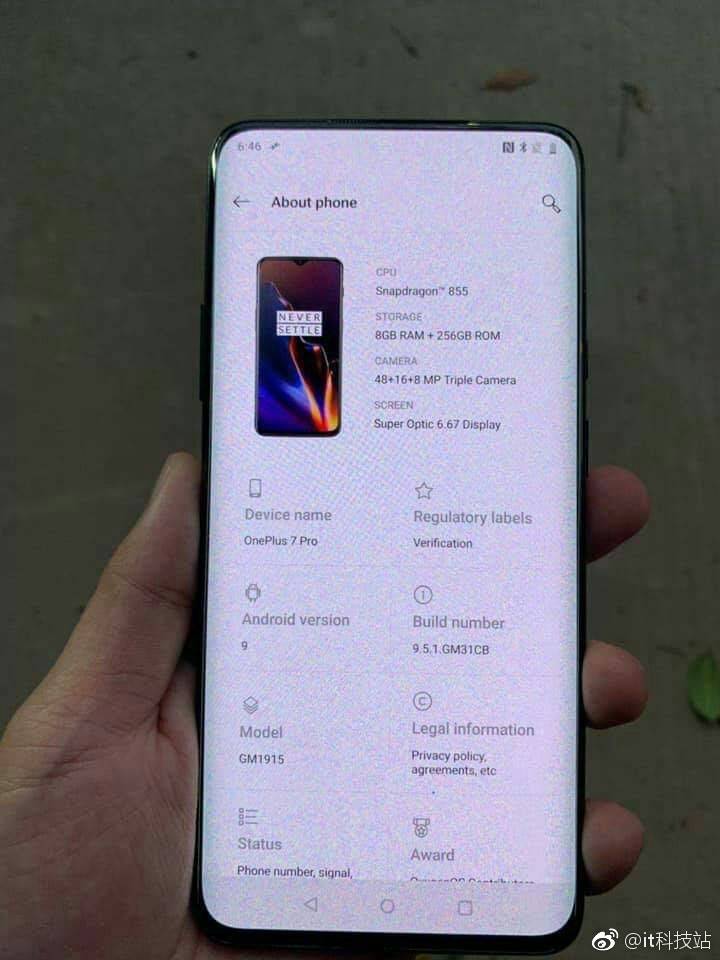
OnePlus may be late to the party, but leaks may be suggesting that OnePlus may not be so worried about it. Alleged real-life images of the OnePlus 7 are beginning to make their way to the internet, as well as a few tidbits to support them. In the images that leaked today via a user on the Chinese forum, Weibo, not only do we get to see the OnePlus 7, but we also get to see a tidbit covering the internals of the device.
Aside from the specs, the striking thing about these images is how unique the OnePlus 7 looks. It has the rounded corners and full-view display from the Vivo lineup, but also has the curved sides of the Samsung Galaxy S10 family.
According to the leak, the OnePlus 7 Pro is said to come with a 6.67-inch Super AMOLED display, a Snapdragon 855 SoC, 8GB memory, 256GB of internal storage, a triple rear camera setup consisting of a 48MP main shooter, and a whole lot more. Furthermore, the device would be running on Android 9 Pie out of the box it seems.
To fill in the gaps regarding the camera setup, we’re looking at a trio of cameras on the rear with no information about the cameras up front. The triple camera setup on the rear consists of a 48MP + 16MP + 8MP dilemma which prompts me to think about the sensors at play here. Given the price that OnePlus would be retailing the device at, there’s no way OnePlus’s going to the pixel binning 48MP sensor from Samsung. Instead, we’re expecting the OnePlus 7 Pro to feature the IMX 586 sensor from the folks over at Sony. However, that isn’t the only thing that we would want to point out. Furthermore, while we don’t wouldn’t speculate about the 8MP sensor at the back of the device, we would speculate that the 16MP sensor on the back may be the same IMX 519 sensor as the ones on the OnePlus 5T, 6, and 6T.
We would only hope that the trio of cameras on the back of the OnePlus 7 Pro feature unique and incredible focal lengths, just like its rivals back home and ashore have done. Given how pretty much everyone has jumped on the triple-camera setup bandwagon, it would only be natural to speculate that the OnePlus 7 Pro’s triple camera setup consists of the main shooter, ultra-wide shooter, and a telephoto shooter just like everyone else.
What’s weird though is the fact that the specs page in the image shows a picture of the OnePlus 6T rather than the OnePlus 7. Furthermore, the device seems to be running a much more toned down version of Android, with a UI that seems to resemble AOSP Pie or some sort. What’s also worth noting is that the device that has leaked is the OnePlus 7 Pro. For the first time, given the name, it seems like OnePlus may release two variants of the device, the OnePlus 7 and the OnePlus 7 Pro.
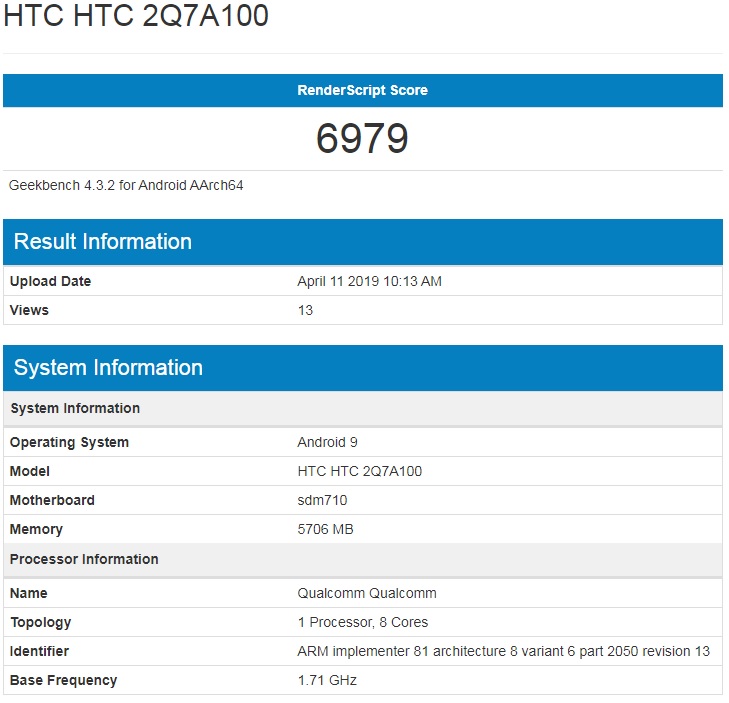
HTC seems to be holding onto the smartphone market for a bit longer. Following reports that suggested HTC of pulling back from a number of regions, a new HTC device dubbed as the HTC 2Q7A100 has emerges on a popular benchmark site’s database, GeekBench.
According to the leak, the alleged HTC-branded device is said to pack a Snapdragon 710 SoC paired with 6GB of RAM. The database revealed what only seemed to be the RenderScript scores of the device, excluding the usual single-core and multi-core test scores. 6979 is the score we’re looking at over here which seems just about for that particular SoC.
Given that the device would feature a mid-rage SoC, we could only predict that this may be the Desire 13 or Desire 13 Plus. Regardless, it would be device launched alongside the Desire nametag.
However, there are few concerns given the dire situation HTC is in right now. Is HTC really planning to launch yet another device, that too, a mid-range device even though HTC hasn’t released anything that challenges the Galaxy S10s and other flagships of 2019. Furthermore, we’re keen to see how HTC plans to launch its upcoming devices as we move forward. 2019 is going to be an important year for us. With LG and Sony still holding on, we’re keen to see where HTC goes from here on.
Epic Games has been consistently been wary of their recent moves. After launching Fortnite Creative last year, Epic Games has decided to bump up the game with the launch of Fortnite Islands today.
With Fortnite Creative Islands, players would be able to experience the best of the community, pushing Fortnite’s custom map game to the upper echelons of enthusiasm. And while Epic hasn’t given a ton of details, it seems like all of these maps are going to come with 12-digit codes that everyone may need to use to get a copy of the map.
So far, Epic has showcased a number of games and possibilities. However, given how large the Fortnite community, we know that it would only get better from here moving forward. We’re looking at game modes that involve golfing, sniping, death runs and a whole lot more.
The new mode is out now. And although Epic hasn’t offered the map codes in text, here are a few maps that you could enjoy, followed by the codes that you may need to enter to jump into that map.
Sky Snipes – 1743-2048-4798
Mini Golf – 6297-1471-3952
Deathrun 3.0 – 4043-5793-6999
These maps are definitely incredible and worthy of showcases for now. Hopefully, folks would be able to take this to the next level. Can’t wait to see how far folks push this new mode. After all, it’s in Epic’s best interest to retain the attention of its players for as long they could, just like any other gaming developer.
After months of wait and desperation, Samsung finally announced their new lineup of Samsung Galaxy S10 series of flagships ahead of MWC 2019. With the Samsung Galaxy S10 family consisting of just three devices initially, Samsung had to put on a show for the folks to admire what Samsung has in store for 2019.
The new lineup from Samsung consisted of three devices, the Samsung Galaxy S10E, S10, and S10 Plus. Following the Samsung Galaxy S9 launch last year, I had an eery feeling that Samsung was holding back a ton of its goodies for the Samsung Galaxy S10 lineup. After waiting a full year to find out what Samsung had in store for its new launch, I went ahead and managed to get a review sample from the kinds folks over at Samsung Malaysia. After using it for the past two weeks, I have quite a few words regarding the device. So here we go.
01 | Build Quality & Design
The Samsung Galaxy S10 Plus is the largest of the bunch, that is before Samsung decided to launch the Galaxy S10 5G earlier this month. While we wait for the Samsung Galaxy S10 5G to roll out in other markets, it seems like the largest device of the bunch is the Galaxy S10 Plus.
The Samsung Galaxy S10 Plus, like previous launches, features beautiful all-glass body. However, while the build materials haven’t been shaken, what has changed is the design language Samsung has introduced with the launch of these devices. In classic Samsung fashion, the Samsung Galaxy S10 Plus uses metal trims across the device and a glass slab on the front and back of the device. And that’s about it.
Coming over to the design of the Samsung Galaxy S10 Plus, the device features an incredible 6.4-inch full display, spanning from corner to corner this year along with virtually non-existent foreheads and chins. After all the leaks and rumors, after two full generations, Samsung finally gave up on the forehead and chin, eventually, pushing the cameras into a cutout of the display. And to their praise, Samsung has done an incredible job at keeping the minimal forehead and leftovers barely noticeable. Not only are the incredibly small, but pair that with Samsung’s signature-like dual curved sides, and you have one beautiful looking device.
The Samsung Galaxy S10 Plus comes in six colorways. The Samsung Galaxy S10 Plus comes in Prism White, Prism Black, Flamingo Pink, Prism Blue, Ceramic White, and Ceramic White. The color that I have today is the Samsung Galaxy S10 Plus in Prism Black. However, to my surprise, at certain angles, the Prism Black S10 Plus resembles the Prism Blue colorway of the Galaxy S10 Plus.
Coming from the Samsung Galaxy Note 9 a few months ago, the Samsung Galaxy S10 Plus looked like a complete behemoth. And although it now resembles the Samsung Galaxy Note 9 here and there, it definitely has it’s own look that makes itself unique compared to the pack. It features the much pointier corners of the Samsung Galaxy Note 9 and shares the incredible front design of the Samsung Galaxy S9 Plus (review).
However, what’s basically bugging everyone with the Samsung Galaxy S10 Plus this year is the button placements. The Samsung Galaxy S10 Plus comes with four buttons across the device. A volume rocker and Bixby button on the right as well as a power button on the right. Like many others, I was bothered by how far the power button is on the Samsung Galaxy S10 Plus. Not only is it too high to reach, but it absolutely annoys me to realize how Samsung threw the ergonomics book out of the window for such a huge device. I mean, it feels like all they cared about this year was the use of the Bixby button, making it easy and within reach. And while I’ll talk about Bixby later, this issue could still be fixed somewhat is Samsung doesn’t mind shoving Bixby wherever they want.
Aside from that bug, what you would be delighted to hear is that the Galaxy S10 Plus still comes with a headphone jack, that too, with a pair of stereo speakers found next to the Type-C port and the earpiece.
Overall, the design of the device was sweet. And the dimensions absolutely back that. Not only is the Samsung Galaxy S10 Plus thinner, but it’s light too. The Samsung Galaxy S9 Plus that preceded the S10 Plus weighs in at 189g. However, the Samsung Galaxy S10 Plus manages to shove off another 14 grams all the while being 7.8mm thin compared to the S9 Plus’ 8.5mm thickness.
Regarding build quality though, like many other glass-back devices, I was personally concerned. There’s no getting around that. However, if you are going for the S10 Plus in the first place, you’re very well aware of what you’re getting yourself into by this point.
02 | Display & Audio Quality
Unlike last year’s Samsung Galaxy S9 Plus, Samsung actually revamped the display on the Samsung Galaxy S10 Plus this year. This year, as we long predicted before the S10 family arrived, comes with an even larger display ratio to work with. This year, the Samsung Galaxy S10 Plus comes with a 6.4-inch 3040 x 1440 Dynamic AMOLED display. However, it’s more than just the specs. Like every single release, Samsung brought major improvements to the display on the Galaxy S10 lineup. The display on the Samsung Galaxy S10 Plus features HDR10+ support, 0.4 JCND, 1215 nits of brightness and improves on the power efficiency on these displays.
Out of the box, the Samsung Galaxy S10 Plus has its display set to 1080p. However, like the Samsung Galaxy S9 Plus before it, Samsung hasn’t included the option of tweaking it while setting up the device itself. Like every other Samsung flagship, we absolutely loved the display on the Samsung Galaxy S10 Plus. The display is sharp, colorful, and bright. Plus, the display supports HDR10+ content which makes the device incredible for media consumption.
However, where the Galaxy S10 Plus speaks volumes in the sound department. Featuring a stereo setup, Samsung has clearly shown what it means to have a device that ticks all of the boxes. Following the struggling days of the Samsung Galaxy S6, Samsung has built an incredible foundation for great audio on the Galaxy S10 Plus despite super modern its design.
The speakers are loud and are vibrant. However, in my personal opinion, it seems like it lacks a bit of clarity, especially when it comes to vocals. The sound is well separated, and so are the volume levels between both of the drivers. Enabling Dolby Atmos on the device simply enlarges the sound stage, nothing too crazy.
The included AKG tweeters with the Samsung Galaxy S10 Plus are great too. They’re small, convenient and great to see. And it’s great to see that Samsung includes them in the box too to compliment the 3.5mm headphone jack on the bottom of the device.
Overall, the time I spent with the Samsung Galaxy S10 Plus was incredible. Media consumption was great and so were the speakers. Sure, there’s a bit of work Samsung could put in here and there. But overall, the device, like the Samsung Galaxy S9 and S8 that preceded it, offers an incredible experience, fit to show why it’s well known to showcase the best of Android.
03 | Performance & User Experience
Depending on your region, you would either get a Snapdragon 855 or an Exynos 9820-powered Samsung Galaxy S10 Plus. And boy, this year they’ve come up with a few new improvements to compliment their prowess.
The one that I have is the Exynos 9820 variant that Samsung largely retails in regions outside of the US. As highlighted earlier this year, the Samsung Exynos 9820 SoC brings a ton of speedy improvements to the Samsung Galaxy S10 Plus. Allegedly dubbed as Cheetah, the 8nm Exynos-powered Galaxy S10 Plus does not disappoint. Clustered in a 2 + 2 + 4 (2.73GHz + 2.31GHz + 1.95GHz) layout, the Samsung Galaxy S10 Plus not only increases its power but also works on the devices power-efficiency spectrum.
Just like every other flagship, the Samsung Galaxy S10 Plus is an absolute beast. The Samsung Galaxy S10 Plus features an Exynos 9820 SoC, 128GB of internal storage, and 8GB of RAM.
For those who still care about scores, the Samsung Galaxy S10 Plus managed to score 328,000 on Antutu’s charts. Over at Geekbench’s turf, the Samsung Galaxy S10 Plus managed to score 4525 and 10124 in the single-core and multi-core department.
The Samsung Galaxy S10 Plus performs like a beast. It zips through applications and games with ease. And thanks to its 8GB of memory, it manages to recall a ton of its “memories” without refreshing anything which was pleasant to see – if you know what I mean. I mean, throw anything at this beast and watch it munch away. Furthermore, the new animations that Samsung added to Samsung’s newly revamped Samsung One UI add a ton of character to the device which was pleasing to see.
Games ran without a hitch, regardless of the resolution. I mean, for a phone this expensive, I wouldn’t expect any less of Samsung at this point. Real Racing 3 and PUBG have become my favorites over the past few months. Being among the more demanding games on the Play Store, I was delighted to see that the Samsung Galaxy S10 Plus managed to run the games incredibly smoothly.
Coming over to Samsung’s newly revamped UI, I was absolutely pleased to see where Samsung is heading. After making multiple iterations and tweaks to TouchWiz, it’s clear that Samsung finally realized that it was time to step up. With the revamped UI, Samsung added a ton of new additions to the new UI, all-the-while retaining Samsung’s signature vibe and features.
As we highlighted earlier this week, we absolutely loved the dark mode that comes with Samsung’s One UI package. Several areas of the UI showcase how well Samsung thought of every single point throughout the display. The Dark Mode dubbed as Night Mode is incredible, dimming pretty much every native/system app which is something I would absolutely miss once I jump back to my Poco F1(review).
Bloatware is still a considerable thing on the Samsung Galaxy S10 Plus, and so are the frustrating apps that come along with it. I mean, I was a bit irritated by the fact that the gesture controls on the Samsung Galaxy S10 Plus often triggered Samsung Pay for no reason. Furthermore, the inclusion of apps such as Samsung Wearable, Game Launcher, Samsung Members and many others continue to question Samsung’s intentions with these applications.
Continuing our surf with Samsung’s One UI, the native system apps and settings app have been revamped for one-handed usage, pushing a number of display elements in the second half of the display. During my usage though, I was riddled to find that the settings section of the device often acted like other phones unless it would pull it down once otherwise. I would’ve personally loved to see every single menu be on the second-half of the display by default rather than forcing me to pull it down every single time. But hey, even though it’s minor, I’d say that it’s a personal gripe.
The Samsung Galaxy S10 Plus has a number of biometric options to unlock the device. Aside from face unlock, PIN, password, and pattern unlock methods, Samsung has introduced an under-display fingerprint sensor, an ultrasonic fingerprint sensor that is. During my usage, I found that the under-display fingerprint sensor to be fast and responsive. Like many other fingerprint sensors, not as fast as many other physical fingerprint sensors. However, we should be seeing even better fingerprint sensors in the upcoming flagships from Samsung.
04 | Camera & Video Quality
The highlight of the new Samsung Galaxy S10 Plus has to be the triple camera setup on its back. After flaunting some incredible shots on the Samsung Galaxy S9 Plus and its dual aperture setup, Samsung decided to spice the Galaxy S10 Plus up even further by including an additional sensor.
This year, the Samsung Galaxy S10 Plus comes with a triple camera setup consisting of a 12MP main camera, a 12MP telephoto, and a 16MP ultra-wide dilemma. All three cameras are hosted in a single bump on the back of the device resembling the design of the Galaxy Note 9 from last year.
Additional specifications of the camera sensors include OIS for two out of the three cameras as well as a dual-aperture system that Samsung ported over from the Samsung Galaxy S9 lineup. Furthermore, the Samsung Galaxy S10 Plus utilizes some large apertures. Beginning with the 12MP main camera, you’re looking at a dual aperture system that flicks between f/1.5 and f/2.4 based on lighting conditions and comes with OIS and Dual Pixel PDAF to assist with focusing. Furthermore, the telephoto and ultrawide shooters come with f/2.4 and f/2.2 apertures as well. Although, the telephoto shooter is the only shooter to get OIS.
Regarding the front cameras, Samsung has finally introduced some incredible additions to the Galaxy S10 Plus. Up front, you’re looking at a 10MP and 8MP dilemma featuring 4K video recording at 30 FPS and depth mapping for those who have been waiting to up their game for a while to add some bokeh to their selfies. However, contrary to what it may seem, only one of the cameras actually takes pictures, this is the 10MP sensor up front. About that 8MP sticking around next to it, that’s there to record depth information.
Below are a number of samples we captured from the Samsung Galaxy S10 Plus over the past two weeks featuring all three perspectives from each camera.
What we were happy to report is that a lot of the shots taken with the Samsung Galaxy S10 Plus looked incredible, regardless of the camera. However, with the whole multiple camera game that manufacturers now have going, it seems like, at times, the Samsung Galaxy S10 Plus jumps between color sciences.
Images taken with the ultra-wide shooter as well as the main camera were sharp, making them more than usable. Images taken with the telephoto shooter had the same qualities as the other two. However, compared to the former two, the shots taken with the telephoto shooter felt a bit soft at times.
The shots taken with the ultra-wide were so good that I began to shoot everything in ultra-wide. The wider field of view in tandem with the incredible experience simply made the ultra-wide shooter my main pick.
However, there were two bugs that bugged me for a while. When switching from the telephoto to the ultra-wide shooter, the camera had a hard time moving between cameras, often making a stop at the main camera in between before making it to either side of the spectrum. Furthermore, while in video, the camera freezes for a split second before moving to the next sensor. As bad as it sounds, it’s super minor. However, it’s up to Samsung to take notice of the issue. Hopefully, Samsung would fix it soon.
Below are a number of video tests we conducted with the Samsung Galaxy S10 Plus.
https://youtu.be/Qd1seYmGfgQ
https://youtu.be/AWRbgRnF6RI
https://youtu.be/pWdM5fpvhwk
https://youtu.be/EpzacmWg6qY
The above videos are simply samples of what the Samsung Galaxy S10 Plus is capable of. The Samsung Galaxy S10 Plus, in my opinion, does an incredible job at recording video. Footage was stable, and so was the sharpness. However, as you begin to move indoors, grain starts to take a major hit on the device’s recording. Sure, we’ve come a long way from the Galaxy S days, but the competition isn’t forgiving either.
And while the cameras were great and versatile for most of the part, I did find that the footage recorded by the Samsung Galaxy S10 was great in a world of excellent smartphone cameras.
05 | Battery Life & Charging Times
The Samsung Galaxy S10 Plus comes with a 4100mAh battery, a full 600mAh bump over the Samsung Galaxy S9 Plus’ 3500mAh battery. Like last year’s Samsung Galaxy S9 Plus, the Samsung Galaxy S10 Plus still doesn’t rock the best head-turning charging times.
I wouldn’t consider myself a power user. For most of the part, the Samsung Galaxy S10 Plus lasted me more than two days if the phone was largely used for a few minutes a day. However, if I would use the device for some social media and YouTube, I found that the device lasted me for about 6-7 hours a day which is respectable. However, what I was surprised to see is how well the Galaxy S10 Plus handled games. After playing PUBG for two hours, I found that the battery had depleted from 80% to 55% in a matter of a few hours which is respectable enough given how demanding the title is. If I wouldn’t be gaming and using the device to simply browse the internet, I found that the device lasted me at least until 11pm at night from 8am in the morning.
Moving over to charging times, after launching 25W fast-charging in China, the Samsung Galaxy S10 Plus still retained its old charging times. During our testing, we found that the Samsung Galaxy S10 Plus took more than one and a half hour to get back up from 0%. Considering that the battery is a whole lot bigger than the Samsung Galaxy S9 Plus from last year, we think that the charging times are respectable in some manner. However, we’re certain that this could be improved in the near future.
06 | Pricing & Conclusion
There’s no doubt that the Samsung Galaxy S10 Plus is an absolute beast. In my opinion, the Samsung Galaxy S10 Plus has to one of the best devices this year and is the best Samsung Galaxy flagship I’ve seen to date, even trumping the Note 9 from late 2018.
Something between the new design and the versatility has me torn. I absolutely adored the device during the time I’ve had it. I mean, the way how the Samsung Galaxy S10 Plus has been built simply tells me that the Samsung Galaxy S10 Plus had been planned for more than a long time. The way how Samsung has delivered on the Samsung Galaxy S10 Plus and how they’ve managed to tick all of the boxes in incredible fashion implies the enjoyment I’ve had with the device over the past two weeks.
Sure, like every other phone, there’s room to improve. Just to name a few, Bixby, Samsung’s OneUI and the triple camera setup, all off these require some minimal changes from Samsung to make the Galaxy S10 Plus perfect. I mean, who still has a headphone jack on their device nowadays?
I simply can’t wait to see what Samsung has in store for the Samsung Galaxy Note 10 which I would speculate would be launching in August this year. Hopefully, Samsung would be able to improve on a number of the aforementioned issues as well as improve the under-display fingerprint sensor before the Note 10 arrives.
In our books, for now, the Samsung Galaxy S10 Plus is a recommendation for us.
If you happen to reside in Malaysia, the Samsung Galaxy S10 Plus retails for about RM 3599 and RM 4499 for the 128GB and 512GB variants of the device, respectively. However, if you happen to reside in the US, the Samsung Galaxy S10 Plus retails for $999 and $1249 for the 128GB and 512GB variant of the S10 Plus, respectively.