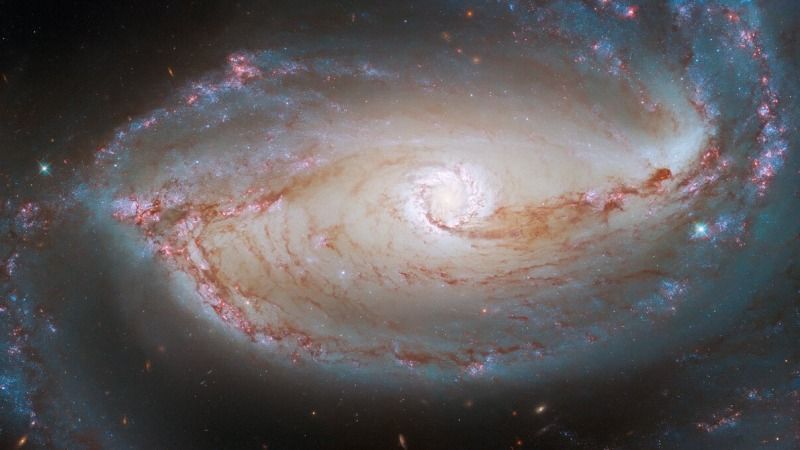
A new Hubble Space Telescope image vividly depicts the core of a faraway galaxy that is organized similarly to our own.
The Hubble Space Telescope (abbreviated HST or Hubble) is a space telescope that was deployed into low Earth orbit in 1990 and is still operational today. It was not the first space telescope, but it is one of the largest and most flexible, regarded as both a critical scientific instrument and a public relations boon for astronomy.
The Hubble Space Telescope is one of NASA’s Great Observatories, together with the Compton Gamma Ray Observatory (1991–2000), the Chandra X-ray Observatory (1999–present), and the Spitzer Space Telescope (2003–2020). It is named after astronomer Edwin Hubble.
The Space Telescope Science Institute (STScI) chooses Hubble’s targets and interprets the accompanying data, while the Goddard Space Flight Center (GSFC) manages the spacecraft.
The new image depicts the “eye” of NGC 1097, a galaxy 48 million light-years distant from Earth. NGC 1097 is a barred spiral galaxy, which means it is similar to the Milky Way.
READ MORE: The creeping part of the San Andreas Fault might cause significant earthquakes
“This image exposes the intricacy of the web of stars and dust in NGC 1097’s core, with the long tendrils of dust etched out in a dark red color,” said officials from the European Space Agency, a Hubble Space Telescope collaborator.
The Wide Field Camera 3 and the Advanced Camera for Surveys atop Hubble also contributed to the high-definition picture. (The latter sensor just marked 20 years in orbit having been installed on a service trip to the observatory in 2002.)
The astonishing new image is based on Hubble’s capacity to see in both visible and infrared (heat-seeking) wavelengths of light, rather than just visible light.
According to ESA officials, the image was produced “using seven distinct filters in total” among the devices, with each camera suited for a unique range of wavelengths. The picture is then colorized in visible wavelengths before being released to the public.
Other observations of NGC 1097, for example, have enabled astronomers to estimate the strength of the black hole.
Tracking the motions of two types of molecular gases surrounding the galaxy’s nucleus, for example, allowed astronomers to estimate the galaxy’s black hole had the mass of 140 million suns in 2015. The Milky Way, on the other hand, is around 4 million suns in size.
For more interesting updates, visit Geeksultd.