At the top of AMD’s chipset lineup is the X570, while at the bottom of the stack is the B550. Both of these chipsets are compatible with AMD’s newest 5000 Series CPUs. Chipset X470 was replaced with B450, which was the previous generation’s chipset.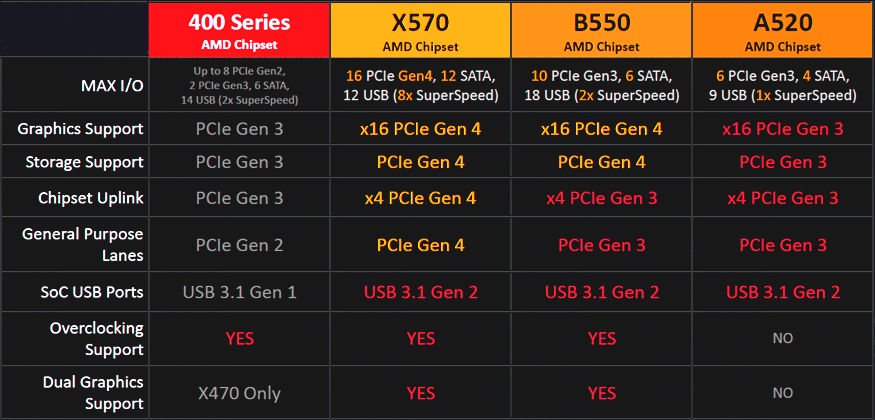
PCIe4.0 (for both GPU and NVMe Storage) and extensive CPU compatibility make X570 and B550 the two best AMD motherboards currently on the market, respectively. As a result, we’ll examine the differences between the X570 and B550 chipsets, weigh the advantages and disadvantages of each, and provide a mini-buying guide to help you make an informed decision.
Comparative Analysis of the B550 and X570 Microprocessors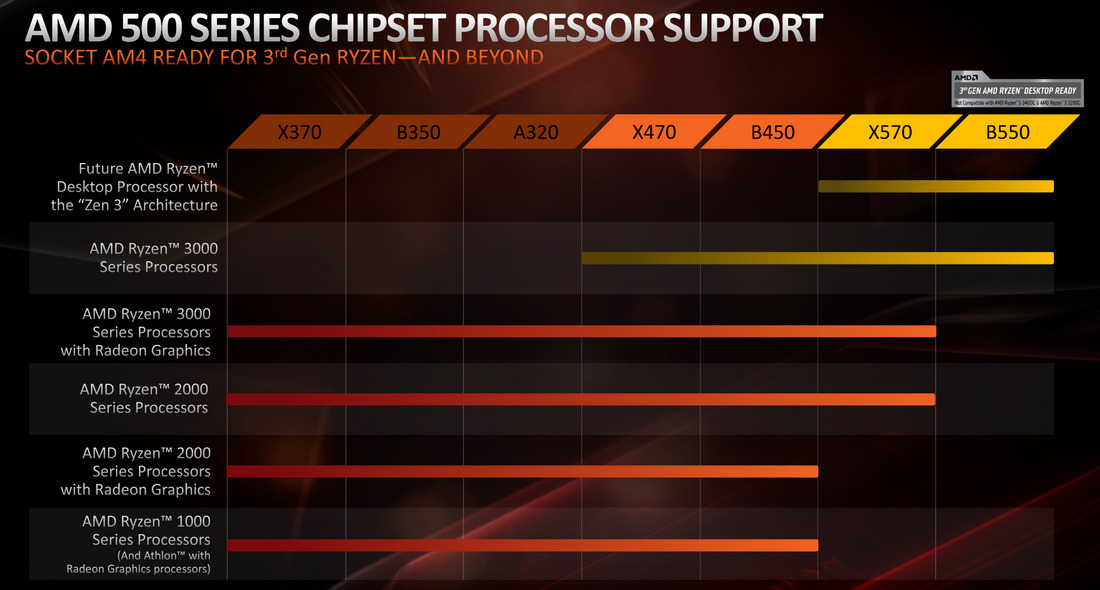
A look at the B550 and X570 chipset specifications is all we’ve seen thus far. Here is a short comparison of the B550 and X570 chipsets.
| Chipset | B550 | X570 |
| Direct CPU PCIe Support for GPU | x16 PCIe 4.0 | x16 PCIe 4.0 |
| Direct CPU PCIe Configuration | 1 x16 or 2 x8 | 1 x16 or 2 x8 |
| CPU to Chipset Downlink | x4 PCIe 3.0 | x4 PCIe 4.0 |
| General Purpose PCIe Lanes from Chipset | PCIe 3.0 | PCIe 4.0 |
| No. of PCIe 4.0 Lanes from Chipset | 0 | 16 |
| No. of PCIe 3.0 Lanes from Chipset | 10 | 0 |
| Chipset SuperSpeed USB 10Gbps Ports
(USB 3.2 Gen 2×1) |
2 | 8 |
| Chipset SuperSpeed USB 5Gbps Ports
(USB 3.2 Gen 1×1) |
2 | 0 |
| Chipset HiSpeed USB 480Mbps Ports (USB 2.0) |
6 | 4 |
| Max Possible Chipset I/O | 10 PCIe 3.0, 6 SATA III (6Gbps), 10 USB (2x10Gbps, 2x5Gbps, and 6x480Mbps) | 16 PCIe 4.0, 12 SATA III (6Gbps), 12 USB (8x10Gbps and 4x480Mbps) |
| Overclocking Support | Yes | Yes |
| Dual Graphics Card Support | Yes | Yes |
| CPU Support | Zen 3 AMD Ryzen 5000,
Zen 2 AMD Ryzen 3000 |
Zen 3 AMD Ryzen 5000,
Zen 2 AMD Ryzen 3000, Zen + AMD Ryzen 2000 |
Chipset differences between the B550 and X570
Chipset PCIe Support
In terms of PCIe lanes, the B550 and X570 chipsets are very different. For the time being, we’ll ignore the CPU’s direct PCIe lanes and focus on the X570 Chipset’s PCIe 4.0 lanes and the B550 Chipset’s PCIe 3.0 lanes.
Since the X570 Chipset only has PCIe 3.0 lanes, the B550 Chipset’s are only PCIe 3.0. Because the GPU is connected directly to the CPU through PCIe 4.0 on both the X570 and B550 motherboards, you can choose the X570 motherboard if you require an extra PCIe 4.0 connection from the chipset. B550 motherboard would suffice in this case.
Performance Tuning and Overclocking
There are overclocking options for both the X570 and B550 motherboards. There are some differences in VRM performance between B550 and X570 motherboards.
The X570’s PCIe lanes are entirely PCIe 4.0, resulting in maximum power demand of 15W. As a result, the chipset on nearly all X570 motherboards is cooled by a fan. In B550 motherboards, this is not the case.
Dual GPU Support
Nvidia’s SLI or AMD’s CrossFire compatibility is required for dual-graphics card configurations in your project. These functions are supported by both X570 and B550 chipsets, however, only a few high-end and premium B550 motherboards support them.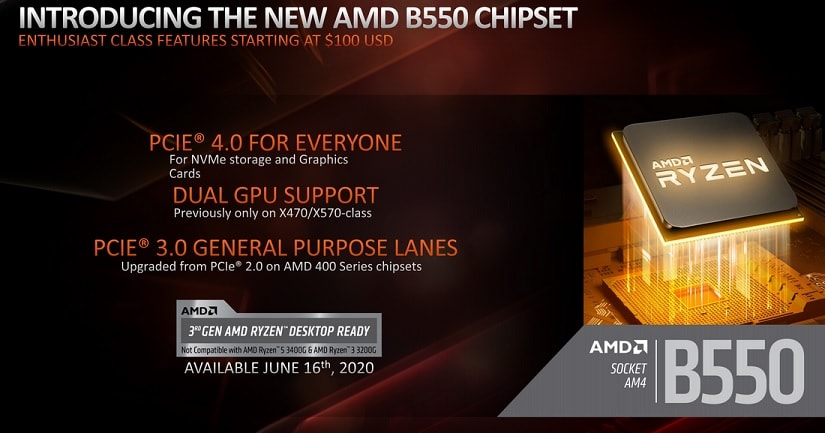
USB and SATA Connectivity
USB and SATA are two more popular methods of data transfer besides PCIe lanes. Only two USB 10Gbps ports are supported on the B550 Chipset, compared to eight on the X570 Chipset. The X570 chipset does not have any USB 5Gpbs ports, but the B550 chipset has two. It contains four USB 2.0 480Mbps connections, whereas the B550 Chipset has six.
If you have an X570 chipset, you can have an additional 8 SATA III 6Gbps ports, whereas if you have a B550 chipset, you can have 2 additional SATA III 6Gbps ports.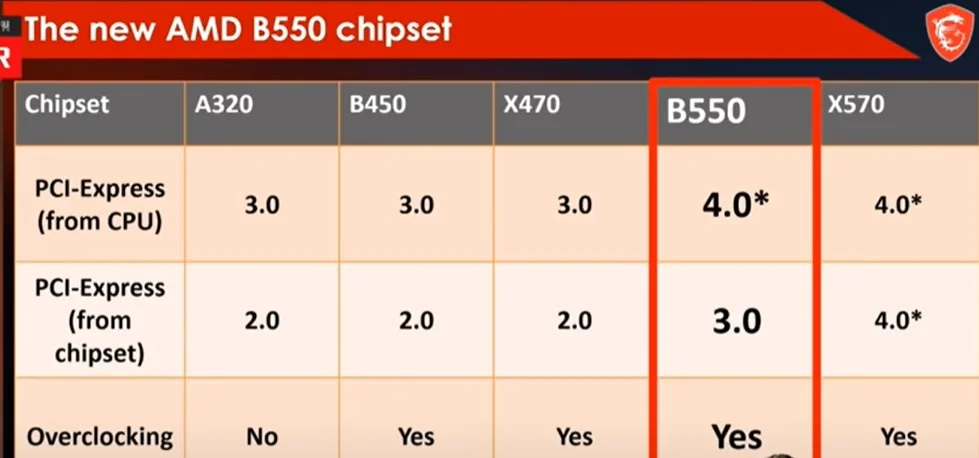
Which Motherboard to Buy, X570 or B550?
From the comparison above, it is evident that the biggest difference between the B550 and X570 chipsets comes down to their PCIe connections. PCIe 4.0 lanes are standard on the X570, whereas PCIe 3.0 lanes are standard on the B550.
Despite this, both chipsets include PCIe 4.0 for the graphics card and M.2 NVMe storage, which is directly connected to the CPU. With PCIe 4.0 GPUs and at least one NVMe storage in the B550 and X570, the cost is a key consideration. In the absence of a requirement for extra PCIe 4.0 lanes, a B550 Motherboard with robust VRMs, overclocking capabilities, and a plethora of other connections is the ideal option.
It is, however, if PCIe 4.0 is a priority that the X570 is the best alternative. For Ryzen 7 and Ryzen 9 CPUs at the top of the price range, you’ll also receive stronger voltage regulators (VRMS).
Conclusion
AMD’s X570 and B550 flagship chipsets are put side by side in this comprehensive review. We compared the key specs of the two chipsets, as well as the differences between the B550 and the X570, and then compiled the results.