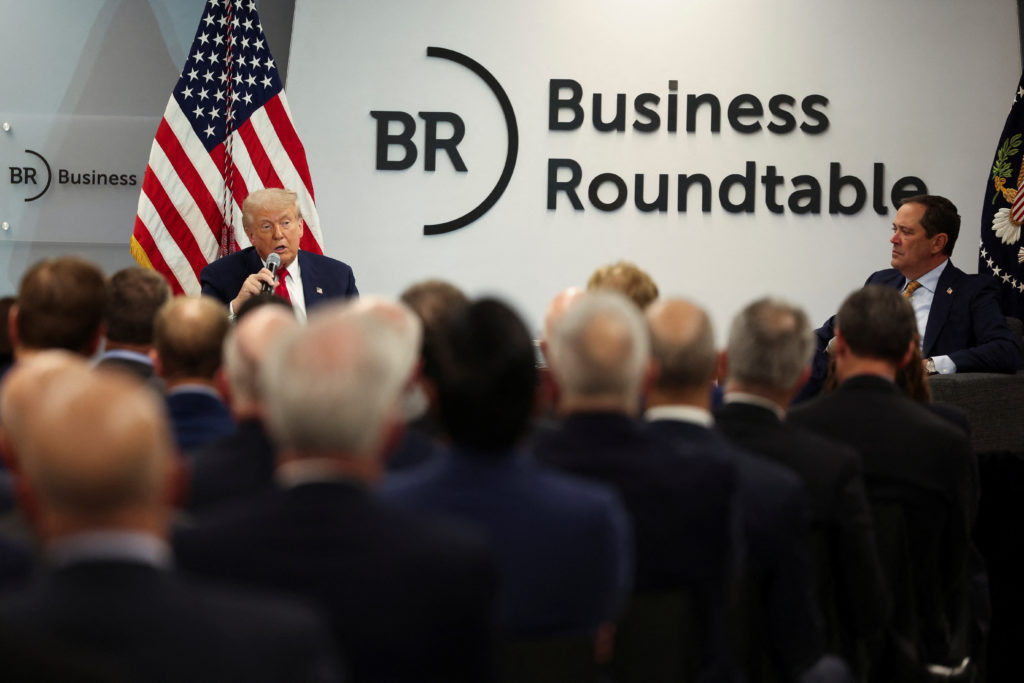
## Trump’s Trade War Talk: Markets Tremble as the President Addresses the Business Elite The air is thick with tension. Markets are jittery, investors are nervous, and the world holds its breath. Against this backdrop of economic uncertainty, President Trump took to the stage to address the Business Roundtable – a gathering of America’s most powerful CEOs. What did he say? And how did the markets react? We break down Trump’s trade war rhetoric and analyze the ripple effects on Wall Street, bringing you the tech-savvy insights you need to understand this high-stakes showdown. Buckle up, it’s going to be a bumpy ride.
Economic Analysis and Implications
Tariffs and Inflation: The effect of tariffs on inflation and the potential for higher prices
The increase in tariffs on steel and aluminum imports from Canada has led to concerns about the impact on inflation. The tariffs, which were initially set at 25%, were doubled to 50% by President Trump in response to Canada’s imposition of duties on electricity exports to the United States. This sudden increase in tariffs has raised concerns about the potential for higher prices for consumers and businesses.
Uncertainty and Economic Slowdown: The impact of tariffs on consumer spending and business investment
The uncertainty surrounding the tariffs has led to a slowdown in consumer spending and business investment. As businesses face uncertainty about the future, they are hesitant to invest in new projects or hire new employees. This can have a ripple effect throughout the economy, leading to a slowdown in economic growth.
Recession Risks: The likelihood of a recession and the potential consequences for the economy and businesses
The risks of a recession are rising as the uncertainty surrounding the tariffs continues to grow. A recession would have severe consequences for the economy and businesses, including job losses, reduced economic growth, and a decrease in consumer spending.

What are the implications for businesses?
Many businesses are struggling to navigate the uncertainty surrounding the tariffs. The increase in tariffs has led to higher costs for businesses, which can be passed on to consumers. However, the uncertainty surrounding the tariffs has also led to a slowdown in consumer spending, which can negatively impact businesses.
Some businesses are also struggling to source materials and products due to the tariffs. The increase in tariffs has led to a shortage of certain materials and products, which can make it difficult for businesses to operate.
- Higher costs: The increase in tariffs has led to higher costs for businesses, which can be passed on to consumers.
- Uncertainty: The uncertainty surrounding the tariffs has led to a slowdown in consumer spending and business investment.
- Shortages: The increase in tariffs has led to a shortage of certain materials and products, which can make it difficult for businesses to operate.
Business Executives’ Concerns
Many business executives are concerned about the impact of the tariffs on their industries and the economy. The increase in tariffs has led to higher costs and uncertainty, which can negatively impact businesses.
One business executive, who wished to remain anonymous, expressed concern about the impact of the tariffs on their industry. “The tariffs are causing uncertainty and higher costs for our business. We are having to adjust our pricing and operations to accommodate the increased costs, which can be difficult for our customers,” they said.
Another business executive, who is a member of the Business Roundtable, expressed similar concerns. “The tariffs are causing uncertainty and higher costs for our businesses. We are urging the administration to find a solution to the tariffs that does not harm American businesses and consumers,” they said.
What are business executives saying about the tariffs?
Many business executives are expressing concerns about the impact of the tariffs on their industries and the economy. Here are some quotes from business executives:
- “The tariffs are causing uncertainty and higher costs for our business. We are having to adjust our pricing and operations to accommodate the increased costs, which can be difficult for our customers.” – Business executive, anonymous
- “The tariffs are causing uncertainty and higher costs for our businesses. We are urging the administration to find a solution to the tariffs that does not harm American businesses and consumers.” – Business executive, member of the Business Roundtable
Uncertainty and Inaction
The uncertainty surrounding the tariffs has led to a slowdown in investment and hiring. Many businesses are hesitant to invest in new projects or hire new employees due to the uncertainty surrounding the tariffs.
One economist, who wished to remain anonymous, expressed concern about the impact of the tariffs on the economy. “The tariffs are causing uncertainty and higher costs for businesses, which can lead to a slowdown in investment and hiring. This can have a ripple effect throughout the economy, leading to a slowdown in economic growth,” they said.
Another economist, who is a member of the Federal Reserve, expressed similar concerns. “The tariffs are causing uncertainty and higher costs for businesses, which can lead to a slowdown in investment and hiring. We are closely monitoring the situation and will make adjustments as necessary to ensure the stability of the economy,” they said.
What are economists saying about the tariffs?
Many economists are expressing concerns about the impact of the tariffs on the economy. Here are some quotes from economists:
- “The tariffs are causing uncertainty and higher costs for businesses, which can lead to a slowdown in investment and hiring. This can have a ripple effect throughout the economy, leading to a slowdown in economic growth.” – Economist, anonymous
- “The tariffs are causing uncertainty and higher costs for businesses, which can lead to a slowdown in investment and hiring. We are closely monitoring the situation and will make adjustments as necessary to ensure the stability of the economy.” – Economist, member of the Federal Reserve
Conclusion
Conclusion: Markets in Turmoil – A Glimpse into the Uncertain Future
As we reflect on the recent remarks by Donald Trump to the Business Roundtable, it’s clear that the markets are bracing for a storm. The article highlighted the key points of Trump’s speech, where he touched upon tariffs, trade uncertainty, and the state of the economy. The significance of this development lies in the far-reaching implications it holds for businesses, investors, and policymakers. The tariffs imposed by Trump have sparked a global trade war, leading to market volatility, reduced consumer confidence, and a slowdown in economic growth.
The impact of these developments is multifaceted, affecting various sectors and industries worldwide. As markets react to the uncertainty, businesses are forced to adapt and pivot to mitigate their losses. The future implications of this ongoing trade war are dire, threatening to undermine global economic stability and potentially leading to a recession. Policymakers must now navigate this treacherous landscape, seeking solutions to resolve the trade disputes and restore confidence in the markets. The clock is ticking, and the world waits with bated breath for a resolution to this crisis.
As we move forward, it’s essential to acknowledge that the stakes are higher than ever. The consequences of inaction will be severe, with far-reaching effects on global economic growth, job security, and consumer well-being. In this climate of uncertainty, one thing is clear: the future of global trade hangs in the balance. Will policymakers rise to the challenge, or will the markets succumb to the weight of uncertainty? The answer to this question will shape the course of history, and the world holds its breath as we wait for the outcome.