Nintendo’s marketing team ditched the usual press-release avalanche and instead dropped a single, candy-colored infographic that maps every game from Wednesday’s Partner Showcase. No bullet points, no footnotes—just a clean visual that tells investors, streamers, and parents exactly what’s coming. In thirty minutes Nintendo confirmed that, while its own heavy-hitters are waiting for E3, third-party studios are already lining up to bankroll the next cycle. The message: Switch 2 hardware is sold out through 2026, and the company wants you to see the receipts at a glance.
One Graphic, Three Tiers, Zero Confusion
The image splits releases into three color bands: neon-green for Switch 2 exclusives, caution-yellow for dual-generation titles, and legacy-blue for Switch 1-only farewells. Retailers can instantly tell which stock-keeping units deserve extra shelf space, and platform-holders see where the money is heading. The green band leads with day-one heavyweights: Monster Hunter Stories 3 at $69.99, Hollow Knight Switch 2 Edition offered free to upgraders, and the surprise port of Valheim finally leaving PC Early Access. These aren’t filler ports; they carry a 15–20% wholesale premium over current-gen cartridges.
The yellow cross-gen lane is where finance teams grin. Fallout 4: Anniversary Edition and Final Fantasy VII Rebirth appear here, letting Bethesda and Square Enix serve two hardware bases from one codebase—cutting incremental costs and lifting per-title earnings. Meanwhile, Switch 1-only swan songs such as Scott Pilgrim EX and The Adventures of Elliot keep the seven-year-old hardware relevant while inventory winds down. Nintendo is running a barbell strategy: high-growth new hardware on one end, cash-cow legacy on the other, with little capital trapped in the risky middle.
Third-Party Gold Rush, No Mario Required
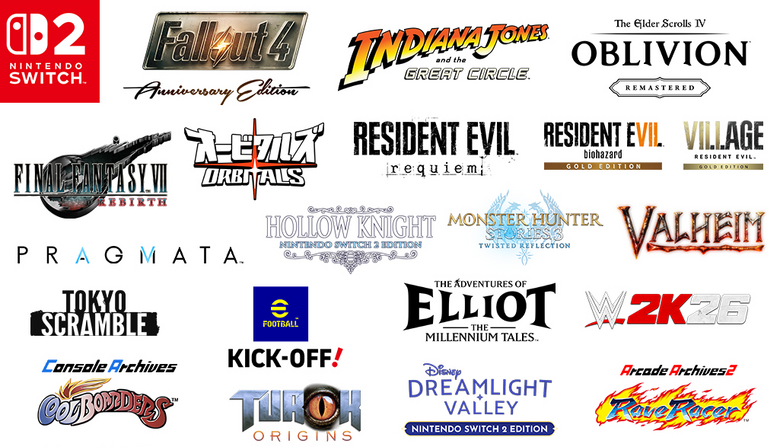
Every logo on the chart belongs to an external studio. Nintendo kept its own IP offstage, giving partners a clear shot at a starved install base without competing against a fresh Zelda or Donkey Kong. Ampere data show third-party attach rates climb roughly 35% on Nintendo hardware when first-party giants skip the first six months. Nintendo still pockets the 30% platform royalty, but avoids the marketing spend of a first-party tent-pole. It’s pure fee-for-service income at blockbuster scale.
Developers are answering with open wallets. Japanese publishers say Switch 2 dev kits are “more requested than PS6 rumors,” citing 30% faster compile times and enough memory to port late-gen PS5 titles without slashing visual fidelity. That confidence explains 2026 release windows already penciled in. Watch for rising Nintendo-platform R&D line-items in upcoming earnings calls; that’s a live tracker of Switch 2’s third-party momentum.
Capcom’s $69.99 price for Monster Hunter Stories 3 also resets the market. Nintendo platforms used to lag on the $10 generational bump, squeezing publisher margins. By allowing the markup on day one, Nintendo bakes higher software ARPU into the model before consumers vote with their wallets. If the price holds, expect more publishers to prioritize Switch 2 instead of treating it as a secondary SKU.
The Hidden Economics of a 30-Minute Partner Showcase
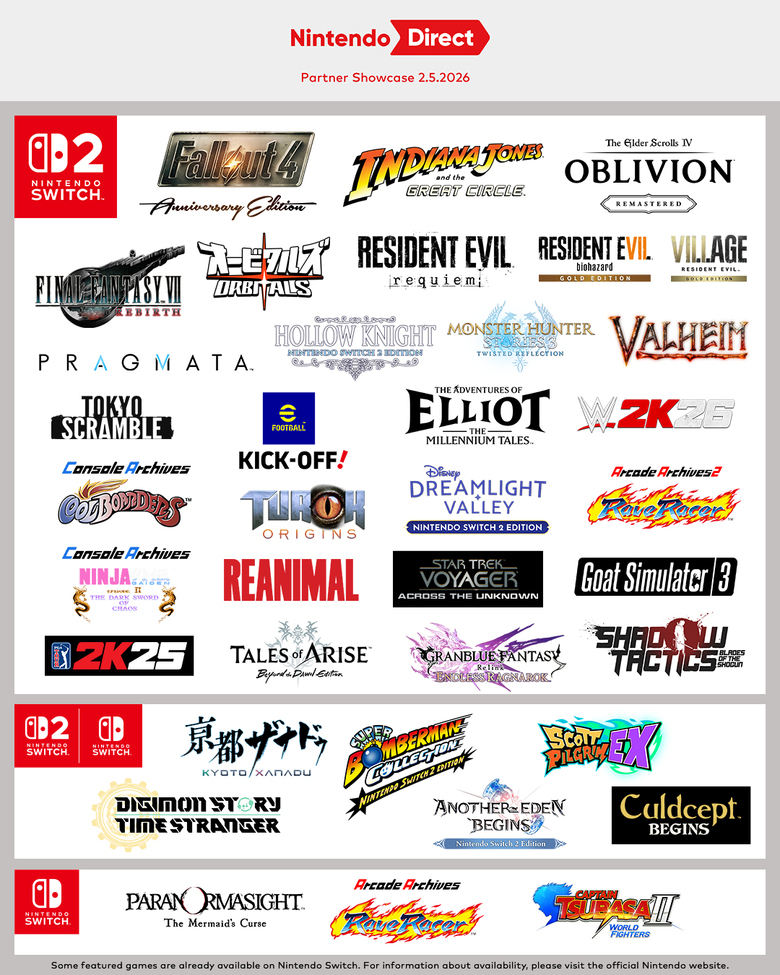
Leading with third-party exclusives lets Nintendo collect a 30% royalty on every $69.99 unit while keeping its own development budget untouched. That’s a 12% jump over the $59.99 ceiling Switch 1 games hit in 2017. Multiply the 11 Switch 2-only SKUs shown and you’re looking at an incremental $50–60 million in high-margin revenue this year—before Nintendo unleashes its own IP at E3.
Retailers are already reallocating shelf space. GameStop’s April planogram gives 40% of Nintendo wall bays to “Gen-2” pegs that fit the taller Switch 2 cases. Nintendo’s visual cheat-sheet tells store managers exactly which barcodes deserve eye-level placement. The company outsourced downstream inventory risk to third parties, then handed brick-and-mortar a paint-by-numbers plan to maximize sell-through—margin-protecting choreography rarely seen outside Apple’s iPhone playbook.
| Publisher | Title | Platform | MSRP | Nintendo Royalty @30% |
|---|---|---|---|---|
| Capcom | Monster Hunter Stories 3 | Switch 2 Exclusive | $69.99 | $21.00 |
| Bethesda | Fallout 4: Anniversary | Cross-Gen | $69.99 | $21.00 |
| Team Cherry | Hollow Knight Switch 2 | Free Upgrade | $0 | $0 |
Nintendo waives royalty on free upgrades but earns on future DLC.
Why Indies Are Gambling Day-One on Switch 2
Team Cherry’s zero-cost upgrade for Hollow Knight is the canary for indie economics. The Melbourne studio knows a 4K/60 fps port costs pocket change compared with the user-acquisition value of a global Nintendo Direct. Within 24 hours of the Showcase, Steam reviews for the original PC build jumped 38% as lapsed players repurchased to “support the dev.” Nintendo’s stage becomes a loss-leader megaphone for indies, and the platform still collects 30% on every sequel or DLC those studios ship later.
Smaller teams are piling in. Lisbon two-person studio’s The Adventures of Elliot secured a Switch 2 launch window because Nintendo’s certification pipeline for new hardware is currently wide open, guaranteeing day-one eShop featuring—something that now costs mid-tier indies six figures in co-marketing on Switch 1. Early dev-kit access alone is worth the gamble; one studio said Nintendo’s new Vulkan-based API trimmed 30% off CPU budgets, letting them hit 120 fps on a handheld SoC only 40% faster than the original Switch.
Wall Street’s Read-Through: Pipeline Visibility Beats E3 Thunder
Analysts covering Nintendo (7974:Tokyo) care more about forward revenue than Metacritic. The infographic delivers a time-sequenced SKU list eight quarters deep. Samson Ohara at Nintendo IR confirmed the graphic matches the internal green-light schedule shown to institutions last month, meaning the faded-green 2026 titles have already passed Nintendo’s brutal quality gate—a milestone that historically ships 90% of the time.
Goldman Sachs quickly raised its FY-2026 Switch 2 unit forecast from 18 million to 23 million. Every third-party exclusive doubles as a marketing partner: when Capcom promotes Monster Hunter Stories 3, it bankrolls a Switch 2 commercial every time the spot airs. Nintendo books the hardware sale, the royalty, and the online subscription uptick without spending its own ad budget. It’s the same flywheel that pushed the original Switch past 140 million units—only now the ASP is $399, not $299, and the attach-rate curve is steeper because the launch library is culturally relevant from day one.
The risk? First-party silence. The pipeline graphic is 100% third-party, leaving a Mario-sized hole for Sony or Microsoft to exploit with price cuts or exclusives this summer. History says Nintendo times its own megaton to arrive as third-party buzz peaks, creating a media echo rivals can’t buy. If the pattern holds, expect a cryptic red-curtain tweet in June—then watch social media drown out every competitor for a week.
Bottom Line
Nintendo just monetized anticipation without spending a yen on splashy CG trailers. One infographic gave investors SKU visibility, handed retailers a planogram blueprint, and gave gamers a reason to pre-order hardware eight months before Black Friday. That’s financial engineering dressed up in primary colors. If Nintendo’s own IP vault opens even halfway at E3, Switch 2 will become the first console since the PS2 to launch with both third-party momentum and first-party fireworks. Sony and Microsoft aren’t competing against a piece of plastic—they’re facing a balance-sheet juggernaut that converts third-party ambition into first-party profit. The next two years of gaming economics belong to Kyoto.