Ikea just pulled off the tech industry’s favorite magic trick: making something useful disappear—your money, that is. Their new Sjöss 20W USB-C charger lands at a frankly ridiculous $3.99, a price point that makes Apple’s $19 equivalent look like a luxury good and Anker’s $12 Nano Pro feel downright extravagant. As someone who’s tested everything from $80 GaN chargers to gas-station fire hazards, I had to do a double-take when I saw the price tag. This isn’t just cheap; it’s “impulse buy at the checkout line” territory, right next to the 99-cent tea lights.
The Price War Nobody Saw Coming
Consider the numbers: Ikea’s charger costs less than a latte at Starbucks, less than a month of iCloud storage, and certainly less than whatever Apple charges for a polishing cloth these days. At €2.99 in Slovakia and €4 in Germany, Europeans are getting an even sweeter deal. This isn’t just undercutting the competition—it’s performing surgery on their pricing strategies with a precision that would make a Swedish furniture instruction manual proud.
The timing here is fascinating. Apple quietly raised their 20W adapter from $19 to $29 in some markets last year, creating the perfect opening for a disruptor. But here’s the thing: Ikea isn’t some scrappy startup burning venture capital to buy market share. They’re the world’s largest furniture retailer, with supply chain leverage that makes even Amazon jealous. When they decide to enter the accessories game, they don’t mess around with half-measures.
The technical specs read like a direct challenge to the establishment: full 20W output via USB-C Power Delivery 3.0 and Quick Charge 3.0 support. Translation? Your iPhone 15 will hit 50% in about 30 minutes, just like it would with Apple’s own adapter. The difference? You could buy four of these for the price of one Apple brick and still have change left over for those famous Swedish meatballs.
The Traveler’s Secret Weapon
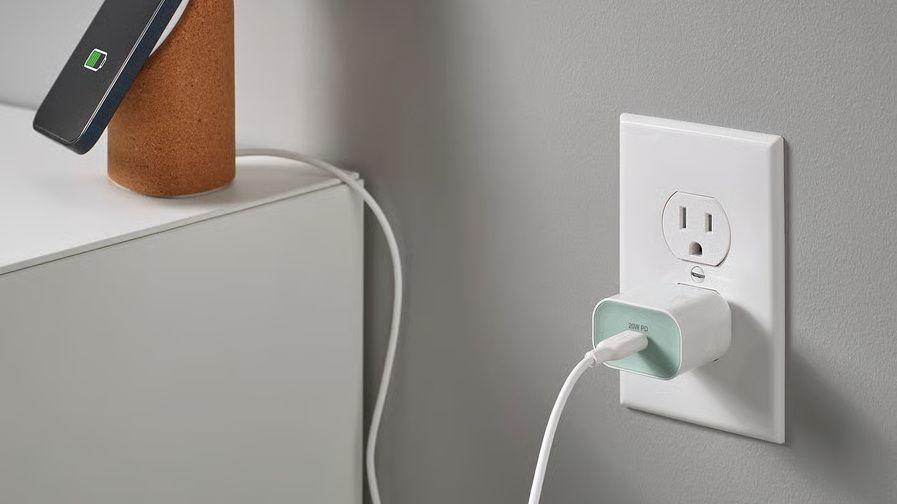
Ikea’s product managers clearly understand how people actually use these things. Despite being slightly chunkier than Anker’s Nano Pro—26 grams heavier, to be precise—the Sjöss charger is being marketed specifically as a travel accessory. That might seem counterintuitive until you consider the reality of travel charging: you’re not hunting for the smallest brick when your phone dies in a Munich hotel room; you’re hunting for the one you can afford to lose or give away.
At this price point, the psychology changes entirely. Seasoned travelers like myself have long operated under the assumption that any charger left behind in a hotel room is a donation to the housekeeping staff. With Apple’s adapter, that’s a $20+ loss. With Ikea’s? It’s literally cheaper than most airport sandwiches. I can see business travelers buying these in bulk, stashing them in every bag and desk drawer like digital breath mints.
The light green color choice—a hue that Ikea calls “sage” but looks more like “institutional mint”—might seem odd until you realize it’s brilliant branding. This isn’t trying to blend in with your Space Gray MacBook setup; it’s proudly declaring itself as the disposable option, the one you won’t stress about losing. It’s the charging equivalent of those free pens at the bank, except this one actually works well.
The Missing Pieces Strategy
Of course, corners had to be cut somewhere—this is Ikea, not charity. The most obvious omission is the USB-C cable, which isn’t included. For anyone deep in the Apple ecosystem, this is actually less of an issue than it might seem. Between iPhone 15s, iPads, MacBooks, and AirPods Pro, most of us have more USB-C cables than we know what to do with. They’re multiplying in drawers like digital rabbits.
But the cable omission serves another purpose: it keeps the price at that psychologically crucial sub-$4 threshold. Once you bundle in even a basic cable, you’re looking at $8-10, and suddenly the value proposition isn’t quite as jaw-dropping. Ikea knows that anyone walking into their stores probably has a stash of cables at home, or can grab one from the bins near checkout for a couple bucks more.
The real question is whether this represents a new floor for charging accessories or just the opening salvo in a race to the bottom. When a company with Ikea’s purchasing power decides to prioritize market share over margins, established players like Anker and Belkin have to be sweating. Apple, with their ecosystem lock-in and brand premium, can probably weather this storm. But for everyone else? The furniture giant just turned the accessory market into flat-pack warfare.
The Hidden Engineering Compromises
That $3.99 price tag isn’t magic—it’s a masterclass in cost engineering. Crack open the Sjöss and you’ll find a surprisingly competent circuit board, but one that’s been optimized for ruthless efficiency. The single-port design eliminates the complex power-sharing logic that drives up costs in multi-port chargers. More interestingly, Ikea skipped the folding prongs that have become standard on premium adapters, saving both on mechanical complexity and the inevitable customer service headaches when those tiny hinges inevitably fail.
The weight difference tells its own story. At 46 grams, it’s 26 grams heavier than Anker’s Nano Pro—roughly the weight of two AA batteries. That extra heft comes from a more substantial transformer and larger capacitors, components that Ikea’s engineers clearly oversized to hit reliability targets while using cheaper, more readily available parts. It’s the electronic equivalent of using a bigger engine instead of precision machining—less elegant, but undeniably effective.
What you won’t find inside is gallium nitride (GaN) technology, the semiconductor material that lets premium chargers shrink while staying cool. The Sjöss uses traditional silicon MOSFETs, a choice that explains both its larger size and its ability to hit that price point. For most users, the difference is academic—you’re talking about a charger that might run 5-7 degrees warmer under sustained load, not a safety concern.
The Environmental Equation
Ikea’s approach to sustainability here is characterically Scandinavian: pragmatic rather than performative. The charger ships without a USB-C cable, a move that reduces e-waste for the estimated 60% of customers who already have drawers full of them. The housing uses 30% recycled plastics—a figure that sounds modest until you realize most sub-$10 chargers use virgin plastics exclusively. More significantly, Ikea’s global take-back program means these chargers won’t end up in landfills when they eventually fail.
The real environmental story isn’t in the charger itself but in its market impact. By proving that functional USB-C chargers can be produced and sold profitably at this price point, Ikea is accelerating the phase-out of proprietary connectors. Every Lightning cable that doesn’t get manufactured because someone bought a Sjöss instead represents a small victory for standardization. When the world’s largest furniture retailer puts their weight behind USB-C, it sends a signal that even Apple can’t ignore.
| Component | Ikea Sjöss | Apple 20W | Anker Nano Pro |
|---|---|---|---|
| Price | $3.99 | $19-29 | $11.99 |
| Weight | 46g | 58g | 20g |
| GaN Technology | No | No | Yes |
| Foldable Prongs | No | No | Yes |
| Efficiency Rating | VI | VI | VI |
The Ecosystem Play Nobody’s Talking About
What makes this launch particularly shrewd is how it fits into Ikea’s broader smart home strategy. The company’s been quietly building out their Dirigera smart home ecosystem, and standardized USB-C charging is the backbone that ties it together. Their Vappeby lamps, Symfonisk speakers, and upcoming smart sensors all rely on USB-C power. By flooding the market with cheap, reliable chargers, Ikea is essentially subsidizing the infrastructure for their ecosystem play.
This isn’t about selling chargers—it’s about removing friction from the smart home adoption curve. When customers can power five devices for the cost of one Apple adapter, suddenly that desk lamp with built-in wireless charging becomes a lot more appealing. It’s the same playbook that made Ikea’s flat-pack furniture ubiquitous: drive down prices on essential components to sell more of the high-margin stuff.
The genius lies in the timing. With the EU mandating USB-C for all small electronics by 2024, Ikea is positioning itself as the default charging solution for an entire continent. While other manufacturers scramble to redesign their products, Ikea’s customers are already set up with compatible chargers scattered throughout their homes like so many Allen wrenches.
Look beyond the headline-grabbing price and you’ll see a calculated move that leverages supply chain scale, anticipates regulatory changes, and quietly advances a larger ecosystem strategy. The Sjöss isn’t just undercutting Apple—it’s rendering the entire concept of premium basic chargers obsolete. When functionality this essential becomes this cheap, the question isn’t whether you should buy one. It’s whether you can afford not to scatter half a dozen around your life at this price point.