The morning mist still clung to the Korean Peninsula when Kim Jong Un raised his binoculars, watching two silver streaks slash across the pearl-gray sky. In the hush that follows a missile launch, the North Korean leader stood flanked by stone-faced generals, their breath clouding in the winter air as the weapons vanished eastward over the Sea of Japan. Less than ten minutes later, state media would triumphantly report, those hypersonic projectiles slammed into practice targets 1,000 kilometers away—roughly the distance from Pyongyang to the outskirts of Tokyo. To most of us, a thousand kilometers is an abstraction; to the engineers who plotted this trajectory, it is a clear warning: we can reach you before you can reach for the phone.
A missile launch timed to the minute
What makes Tuesday’s test pulse with geopolitical electricity is its choreography. South Korean President Lee Jae-myung had just touched down in Beijing for a red-carpet summit with Xi Jinping, hoping to coax China—Pyongyang’s economic lifeline—into nudging its neighbor toward restraint. While Lee’s motorcade idled outside the Great Hall of the People, North Korea’s Academy of Defense Science pressed the fire button. Two ballistic signatures bloomed on early-warning radars in Seoul and Tokyo, a blunt reminder that calendars in the region are often set to Pyongyang Time.
Hypersonic is the word that keeps Pentagon planners awake at night. These missiles travel at more than five times the speed of sound—about 6,200 kilometers per hour—skimming the upper atmosphere like skipping stones. Because they can zig-zag at relatively low altitudes, today’s interceptors struggle to swat them down. Imagine trying to deflect a bullet already in flight; now imagine that bullet can turn corners. Kim’s engineers have christened their version the Hwasong-8, and each test shortens the technological gap between North Korea and the superpowers who once dismissed its arsenal as Soviet-era relics.
The language of deterrence, Pyongyang-style
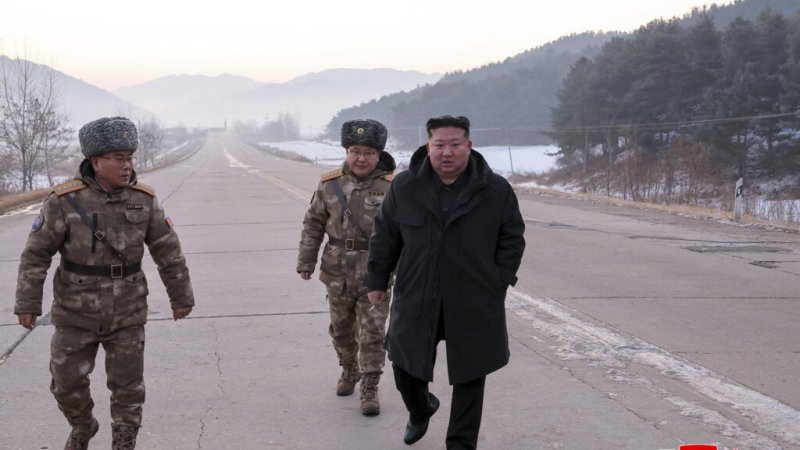
State television, always eager to frame the narrative, cut from the launch to a mahogany-paneled briefing room. There, Kim addressed his military elite with the calm of a professor explaining a theorem. Maintaining a “powerful nuclear deterrent,” he said, is “a very important strategy” given “the recent geopolitical crisis and various international circumstances.” He never named the crisis—was it stalled talks with Washington? Joint U.S.–South Korean air drills over the Yellow Sea? Or simply the widening economic chasm between his sanctioned state and its southern neighbor?
Outside analysts comb every syllable of these speeches for shifts in tone. This one carried an unmistakable urgency: the missile units were ordered to ready the country’s war deterrent “for actual war,” not merely for parade-ground display. In Pyongyang’s lexicon, “actual war” is not hyperbole; it is a bureaucratic category that triggers distribution of extra rice rations to troops and dispersal of mobile launchers to mountain tunnels. For civilians, it means another round of blackout drills and mandatory ideological study sessions titled “We Are Invincible.”
Yet beneath the bellicose rhetoric lies a regime that still craves recognition. Kim’s scientists did not launch intercontinental ballistic missiles capable of striking California; they fired mid-range hypersonic gliders that stop just short of inviting an American pre-emptive response. It is provocation calibrated to the millimeter, a reminder that North Korea’s favorite bargaining chip is the implied threat of escalation. The message to Washington: talk to us, or we will keep sharpening the blade until it can reach Guam—and beyond.
Neighborhood watch, with radars spinning
From concrete bunkers beneath Seoul’s hills, South Korean intelligence officers replay infrared footage of the launch. They note that the missiles were fired from a previously unused site near the western coastal city of Nampo, suggesting North Korea can now stage surprise tests from mobile platforms hidden in highway tunnels. Japan’s defense minister told reporters the projectiles splashed down outside the country’s exclusive economic zone, politely omitting that fishing boats had been ordered back to port hours earlier.
China, whose Foreign Ministry spokesman was fielding questions about President Lee’s visit when news of the test broke, urged “all parties to stay calm.” Behind the scenes, Beijing has quietly tightened export controls on specialty steels and high-performance computers—materials vital for missile guidance systems. It is a delicate dance: keep Pyongyang dependent enough to prevent outright collapse, yet restrained enough to avoid triggering a regional arms race that would bring more U.S. missile-defense batteries to Northeast Asia.
In Washington, the National Security Council convened a late-evening video call with counterparts in Seoul and Tokyo. A senior U.S. official, speaking on condition of anonymity, said the launch “underscores the urgent need for dialogue,” but conceded that back-channel messages sent through the North Korean mission at the United Nations have gone unanswered since last summer. Meanwhile, the USS Ronald Reagan carrier strike group extended its patrol in the Philippine Sea, its fighter jets catapulting into the dusk sky—an iron fist cloaked in afterburner glow.
The physics of panic: why hypersonics change the calculus
Inside the war-gaming rooms of Seoul’s Yongsan district, analysts speak of a “compressed decision window.” A conventional intermediate-range missile gives Japan and South Korea roughly twelve minutes from launch detection to impact; a hypersonic glide vehicle slices that to six. In those 360 seconds, operators must confirm the track, wake political leaders, run impact predictions, and decide whether to retaliate. The math is brutal: every 30-second delay equals 50 kilometers closer to Tokyo.
| Missile type | Speed (Mach) | Time-to-target (1,000 km) | Intercept success rate |
|---|---|---|---|
| Scud-class | 5 | 11 min | 70 % |
| IRBM | 10 | 9 min | 45 % |
| Hwasong-8 hypersonic | 15+ | 6 min | <20 % |
U.S. Congressional Budget Office estimates against maneuvering targets
But raw speed is only half the nightmare. Hypersonics bleed altitude as they glide, ducking under the high-arching trajectories that early-warning radars are tuned to spot. Picture a hawk folding its wings to knife between trees instead of soaring overhead. By the time Japan’s Aegis destroyers paint the object, it may already be abeam of Mount Fuji. Pyongyang’s engineers have exploited this blind spot, firing the Hwasong-8 on a depressed arc that never climbs above 80 kilometers—too low for the lofty gaze of U.S. Space-Based Infrared satellites, too high for Patriot batteries to swat.
The psychological payload is delivered long before any warhead. Each test rewrites the mental map of safety for 120 million Japanese and 52 million South Koreans. In Osaka, elevator companies report spikes in emergency calls the moment NHK flashes a “missile launch” banner. Parents on Jeju Island now pack policy/d_policy.html”>Ship-to-Ship missile interceptors. Shares of Raytheon and Mitsubishi Heavy spiked 4 % within an hour of the launch, a tidy dividend from crisis. Even Korean shipbuilders have caught the updraft: orders for Aegis-equipped destroyers now stretch out to 2029, each hull priced at $900 million—roughly Pyongyang’s entire declared military budget for a year.
Yet the biggest windfall may accrue to Kim himself. By brandishing a weapon that can outrun diplomacy, he tightens the external squeeze that justifies internal sacrifice. State television’s nightly montage—missile streaks, cheering factory workers, Kim jotting notes on a snowy tarmac—feeds a narrative that only the Workers’ Party can keep the wolf of American invasion from the door. In a country where average monthly wages hover near $2, the appeal of belonging to a “thermonuclear power” is potent currency.
Conclusion: the echo of engines
I keep replaying the moment the second missile vanished over the horizon. Somewhere beyond the camera frame, its heat shield glowed white-hot as it slammed into the stratosphere, shepherded by engineers who once learned physics from tattered Soviet textbooks. Their triumph is measured not in kilometers per hour but in the hush that settles over Seoul coffee shops when the emergency alert vibrates across smartphones.
History teaches us that every breakthrough in speed—steam, rail, flight—reshaped the world faster than laws could follow. Hypersonics are the new steam, and Kim Jong Un has opened the throttle wide. The rest of us are still learning the timetable. One day, perhaps, a treaty will catch up with the technology. Until then, the Sea of Japan will keep swallowing these silver streaks, and the quiet between launches will feel less like peace than a held breath, counting down the minutes until the next sonic boom reminds us how quickly tomorrow can arrive.