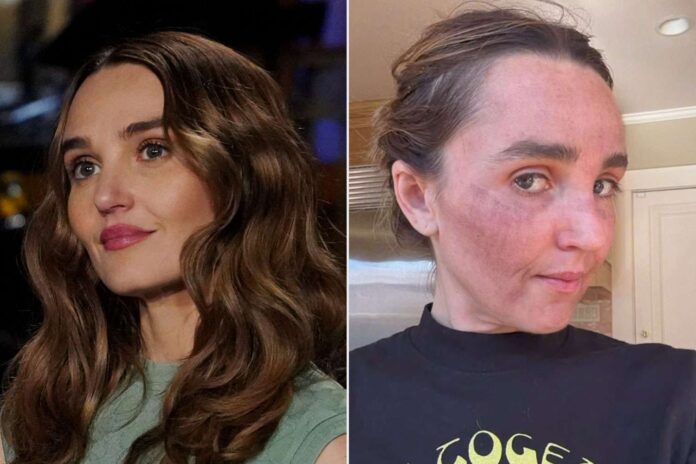
The actress who once sprinted through jungle sets and traded quips with superheroes is now fighting a battle no stunt coordinator can choreograph. Evangeline Lilly, 45, has revealed that a simple beach walk last May ended with her unconscious on Hawaiian sand, blood soaking into the shore, and a diagnosis that would reshape everything: brain damage.
On New Year’s Day, Lilly posted an unfiltered Instagram video from her living room. She described regaining consciousness face-down after fainting, her forehead split open from striking a boulder. Weeks of blurred vision and stabbing headaches followed. “I thought I’d heal,” she says, voice cracking, “but the scans don’t lie—almost every region of my brain is running on fumes.” For someone whose career demanded sharp timing and emotional precision, the news felt like betrayal by her own body.
A Lifetime of Unanswered Blackouts
Friends say the beach incident wasn’t her first unexplained collapse. Since childhood, Lilly has experienced sudden blackouts—moments when she’d stare blankly before crumpling, only to wake minutes later with no memory. EEGs, MRIs, and heart monitors always came back clean. “Doctors called them ‘idiopathic events,'” she tells viewers, managing a wry smile—medical speak for ‘we don’t know.’
During Lost, crew members kept a canvas cot nearby in case she dropped mid-scene. On Marvel sets, stunt doubles occasionally stepped in when dizziness hit. She laughed off these “glitches” as the cost of a packed schedule. But last May’s fall—fracturing her orbital bone and causing a concussion that deepened into cognitive decline—couldn’t be dismissed.
Neurologists now believe each faint quietly damaged microscopic brain circuitry. “Think of it like rain eroding a hillside,” one specialist explained. “One storm may cause the landslide, but the ground’s been shifting for years.” Lilly admits the metaphor offers grim validation: decades of questions finally answered, just not how she’d hoped.
Reading the Scars on Her Own Scans
Lilly’s video lingers on pastel brain scans splashed with navy zones where activity has dipped dangerously low. “I thought the injury was localized,” she says, tracing an image that resembles a weather map more than medical imagery. “Turns out it’s a systemic brownout.” Memory, speech, and spatial orientation sectors all show deficits; even creativity centers—once her professional engine—glow faintly.
When doctors compared recent scans to a baseline taken years earlier, processing speed had dropped 18 percent. Verbal fluency declined sharply. Attention flickered like faulty neon. “Words hide from me mid-sentence,” she admits. “I walk into rooms and forget why I entered. Some mornings I feel like I’m wearing my brain backward.”
Yet the diagnosis brought unexpected freedom. No longer hiding lapses, she schedules cognitive therapy, neuro-feedback sessions, and deliberate rest. “I’ve traded red-carpet heels for walking poles,” she jokes, showing sleek trekking poles by her door. Where she once memorized scripts overnight, she now practices mindfulness exercises focusing on a single raisin for five minutes—initially maddening, now calming.
Finding Superpowers in Slow Motion

Hollywood doesn’t wait for neural healing. Studios still offer roles requiring fourteen-hour days and split-second timing. Her instinct says yes—until concussion symptoms flare like warning lights. So Lilly is trying something radical for an A-lister: saying no.
She’s limiting projects to short shoots near her Canadian home, lobbying productions to build cognitive-rest breaks into everyone’s schedule. The slower pace has unexpectedly sharpened neglected artistic skills. “I’m listening better, reacting smaller,” she notes. In a recent voice-over session, a director kept a take where Lilly pauses mid-thought—three seconds of silence that once would’ve been edited out. Friends say conversations with her—once rapid-fire—now meander thoughtfully. She compares the shift to switching from espresso to herbal tea: “You taste notes you never noticed before.”
Whether these nuances can coexist with an industry that prizes speed remains uncertain. Turning down roles means leaning on savings; insurance companies hesitate to cover long-term cognitive rehab for an injury labeled “mild” TBI. She views the challenge as another chapter in a life that swung from oil-rig secretary to global star. “I’ve played survivors,” she says, smiling faintly. “Now I get to become one in real time.”
Inside the Neurological Labyrinth
Traumatic brain injury rarely travels alone—it brings memory potholes, word-finding detours, emotional storms. Lilly’s latest neuro-psych report shows verbal fluency at the 18th percentile for her age; processing speed at the 9th. A script page that once took ten minutes to memorize now demands an hour of repetition. A grocery list evaporates before she finds her car keys.
The scan that stunned her most was a color-coded PET image: patches of hypo-metabolism blooming like cold bruises across both hemispheres. Specialists confirm such diffuse slowing after a focal impact occurs when microscopic shearing disrupts neural super-highways. Recovery is possible, but predicting its trajectory is closer to weather forecasting than engineering.
| Cognitive Domain | Pre-Injury Estimate | Current Percentile | Everyday Impact |
|---|---|---|---|
| Processing Speed | 70th | 9th | Misses conversation beats; delays on set |
| Verbal Fluency | 75th | 18th | Script line retrieval “like wading through mud” |
| Visual Memory | 80th | 22nd | Trouble recalling blocking marks |
| Sustained Attention | 65th | 14th | Needs mid-day neural rest periods |
Estimates based on academic records and screen-test archive review.
Hollywood’s Hidden Head Trauma Epidemic
Lilly’s honesty cracks open an industry-wide silence. Stunt coordinators privately admit “mild” concussions are often logged as “stunt neck strain,” never reported to insurers. A 2020 U.S. Occupational Safety and Health Administration white paper found film sets report head injuries at twice the rate of general construction, though under-reporting may hide steeper numbers. The culture is simple: time costs $300,000 an hour, and hospital runs derail shooting days.
Lilly questions whether earlier “klutzy moments”—falling off a wire rig in 2015, a trailer door bump causing vomiting—were prior concussions. “We wear seatbelts in chase scenes, but who wears a helmet between takes?” She’s advocating for “neuro-safety captains,” on-set medics trained to screen pupils after any impact. “If we can have intimacy coordinators, surely we can afford brain advocates.”
Other performers are quietly rallying. One Marvel co-star texted: “I’ve had four concussions on set—never told anyone. Let’s fix this.” Lilly is partnering with Toronto’s Holland Bloorview Kids Rehab Hospital to adapt their youth concussion protocol for stunt-heavy productions.
The Slow, Defiant Comeback
Recovery is a tapestry of micro-victories: finishing Sudoku without a nap, driving two freeway exits before the world tilts, remembering her son’s karate belt color. Mornings begin with red-light therapy and forty minutes in a rented hyperbaric capsule dominating her spare room. “I call it my time machine—it’s either taking me back to health or ahead to a future I can handle.”
She’s returned tentatively to acting—voice-over first, where retakes are forgiving. An indie director rewrote a role so her character speaks in halting bursts, mirroring Lilly’s current cadence. She’s limited herself to four-hour days, with blackout curtains ready when light sensitivity spikes.
In rebellion against Hollywood’s hustle gospel, Lilly schedules “white-space days”: twenty-four hours with no stimuli—no emails, no scripts—just wind in the cedars outside her Squamish cabin. Neuroscientists call this “environmental enrichment deprivation”; she calls it “lying fallow,” letting her mind rest before the next bloom.
Epilogue: The Unfinished Map
Brain injury is the rare voyage where the traveler pays after the ship sails. Lilly doesn’t know if she’ll reclaim the cognitive sharpness that once let her improvise in Elvish or spar verbally with Paul Rudd. What she owns is the narrative. By naming her damage aloud, she’s trading shame for stewardship, turning private wreckage into public blueprint.
“I used to think strength was crashing through walls,” she says, voice steady. “Maybe it’s sitting inside a broken room and believing you can still decorate.” The landscape of her mind may be altered, but maps are drawn by explorers, not tourists—and explorers know the greatest discoveries happen when the trail runs out.