## From Fluffy Clouds to Killer Tornadoes: How Weather Science Saves Lives
Ever looked up at the sky and wondered how those fluffy clouds morph into raging storms? Or perhaps you’ve felt the awe-inspiring power of a hurricane, leaving you thankful for a roof over your head.

Weather, the invisible force shaping our world, is more than just sunshine and showers. It’s a complex dance of atmospheric patterns, driven by intricate scientific principles. And behind the scenes, a dedicated organization is working tirelessly to decipher these patterns, turning raw weather data into life-saving predictions. This is the story of the World Meteorological Organization (WMO), the unsung heroes of weather forecasting, and how their science is powering our ability to prepare for and mitigate the impacts of a changing climate.

The Green Climate Fund (GCF) and World Meteorological Organization (WMO) Collaboration
The Green Climate Fund (GCF) and World Meteorological Organization (WMO) have joined forces to provide the international community with new climate information and tools based on the latest climate science data. This collaboration aims to inform decisions on climate change investments, particularly for adaptation.
Joint Initiative for Climate Information and Tools
This joint initiative was announced at the United Nations Climate Change conference, COP26 (Glasgow) on 3 November. It is one of a number of WMO activities to translate science into policy support to help tackle climate change drivers and impacts and to build resilience to increasingly extreme weather.

Climate Science Information for Climate Action Resource Pack
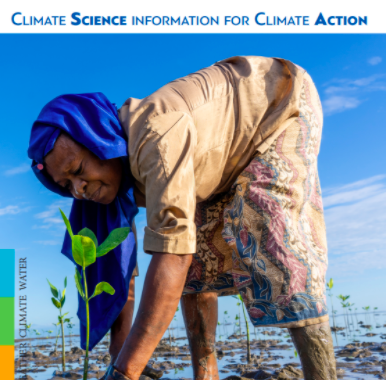
The Climate Science Information for Climate Action resource pack includes detailed technical guidance, case studies, and two online platforms:
- A Climate Information Platform that provides access to projections of over a dozen climate change indices for the globe, for example, coupled atmospheric and ocean monitoring and regional climate modeling (Home – Climate Information).
- Online access to Climpact – for calculation of over 70 indices associated with climate impacts, from historical daily temperature and precipitation data (Climpact (climpact-sci.org)).
An accompanying guidance document explains how these tools can be used to recognize climatic and non-climatic factors contributing to socio-economic and environmental impacts, to guide the identification of effective climate actions.
Online Platforms and Guidance Document
These knowledge products are particularly useful for adaptation planning and in the development of proposals for climate finance. They were developed by WMO experts working with national and international partners in Cabo Verde, Cambodia, Democratic Republic of Congo, and St. Lucia.
Supporting Countries in Making Informed Climate Investment Decisions
Through this collaboration, WMO is supporting countries to make informed climate investment decisions based on the best available science. These resources will be valuable across a range of climate-sensitive sectors, including agriculture, coastal management, disaster risk reduction, energy, fisheries, forestry, health, and water.
Use of the Best Available Science
According to WMO Secretary-General Prof. Petteri Taalas, “These resources will be valuable across a range of climate-sensitive sectors, including agriculture, coastal management, disaster risk reduction, energy, fisheries, forestry, health, and water.”
Climate-Sensitive Sectors and Adaptation Planning
The Climate Science Information for Climate Action resource pack is designed to support countries in making informed climate investment decisions, particularly for adaptation planning and in the development of proposals for climate finance.
Development of Proposals for Climate Finance
The guidance document accompanying the resource pack explains how these tools can be used to recognize climatic and non-climatic factors contributing to socio-economic and environmental impacts, to guide the identification of effective climate actions.
Ongoing Collaboration and Stakeholder Engagement
Through continuing collaboration, WMO and the GCF will use their mutual networks to support and engage with the stakeholder community to demonstrate the applicability of these knowledge products and gather user feedback for further enhancement of these tools.
Continuing Partnership between WMO and GCF
The side event in the COP26 Science Pavilion launched and showcased the knowledge products that have been jointly developed, and initiates an ongoing process of providing support, particularly to developing countries, with the aim of ensuring that all Parties can access the best available scientific information in support of national priorities for climate action.
Engagement with the Stakeholder Community
The WMO and GCF will work together to engage with the stakeholder community to demonstrate the applicability of these knowledge products and gather user feedback for further enhancement of these tools.
Gathering User Feedback and Enhancing Tools
Through this ongoing collaboration, WMO and the GCF will gather user feedback to further enhance these knowledge products and ensure they meet the needs of the stakeholder community.
Practical Aspects and Implications
The collaboration between WMO and GCF has significant practical implications for climate action and adaptation planning.
The Importance of Urgent Mitigation Action
According to the State of Climate Science, human-caused climate change has resulted in widespread and rapid changes in the atmosphere, ocean, cryosphere, and biosphere. The year 2023 was the warmest on record by a large margin, with widespread extreme weather. This trend continued in the first half of 2024.
Global greenhouse gas (GHG) emissions rose by 1.2% from 2021 to 2022, reaching 57.4 billion tons of carbon dioxide (CO2) equivalent. Globally averaged surface concentrations of CO2, methane (CH4), and nitrous oxide (N2O) also reached new highs.
To limit global warming to below 2°C and 1.5°C (above the pre-industrial era), global GHG emissions in 2030 must be reduced by 28% and 42%, respectively, from the levels projected from current policies.
The Role of AI, Machine Learning, and Space-Based Earth Observations
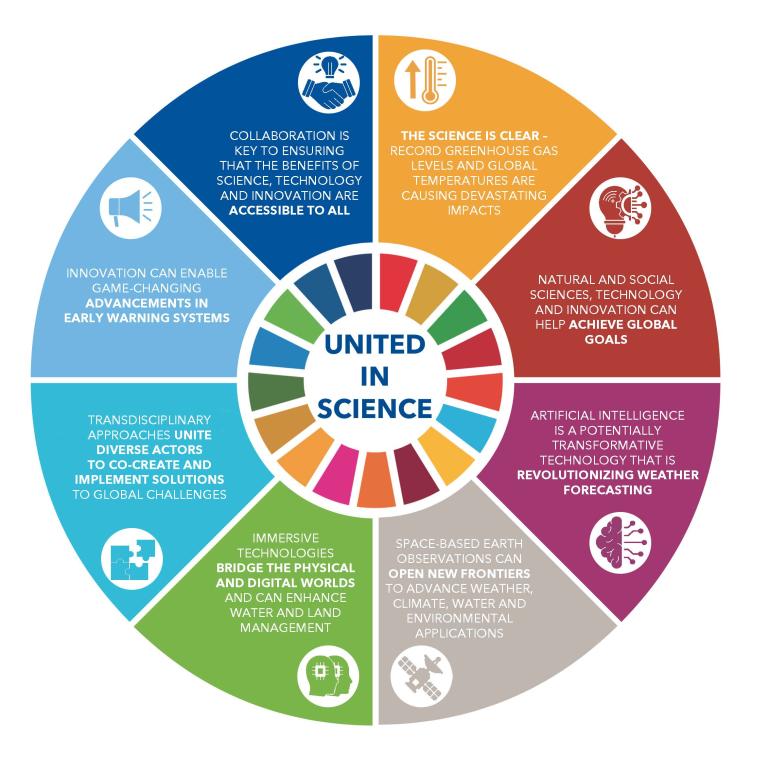
Artificial intelligence (AI) and machine learning (ML) can revolutionize weather forecasting, making it faster, cheaper, and more accessible to lower-income countries with limited computational capacities.
Space-based Earth observations offer vast opportunities for the future. High-resolution and high-frequency observations of the Earth system are crucial for effective weather forecasting, climate prediction, and environmental monitoring.
Building Resilience to Extreme Weather Events
The improvements in science and operational predictions are driven by international cooperation, which then can drive sustainable development. The WMO World Weather Research Programme (WWRP) promotes research to improve weather prediction, and its impacts on society, for minutes to months ahead.
The WWRP’s key objectives are to advance research of the Earth system on timescales from minutes to months, improve the warning process to account for increasing risks and the evolving nature of extreme weather impacts, and quantify and reduce uncertainty in predictions on time scales from minutes to months.
Conclusion
Conclusion:
The article “Science for Action: Weather – World Meteorological Organization WMO” sheds light on the crucial role of weather forecasting in addressing global challenges. WMO’s efforts to improve weather forecasting have been instrumental in saving countless lives, mitigating natural disasters, and driving economic growth. By highlighting the key points and main arguments discussed in the article, we’ve gained a deeper understanding of the importance of weather forecasting in the modern world.
The significance of WMO’s work cannot be overstated. The World Meteorological Organization’s mission to “save lives and improve weather forecasting” is a lofty one, and their efforts have borne remarkable results. From predicting and preventing hurricanes to tracking and mitigating the effects of heatwaves and droughts, WMO’s contributions have been invaluable in shaping our response to severe weather events. Moreover, the data-driven approaches employed by WMO have also helped to improve public health, agriculture, and economic development.
The implications of WMO’s work extend far beyond the realm of weather forecasting. By advancing our understanding of the complexities of the atmosphere and the challenges associated with climate change, WMO’s research has significant implications for policymakers, business leaders, and individuals seeking to mitigate the impacts of extreme weather events. As we look to the future, it is clear that continued investment in weather forecasting and climate research will be crucial in addressing the pressing challenges of our time.